



 Be The Investor Research
Earnings Week Tests Credit, AI Spending and the Consumer

Capital One, Meta and a broad group of industrial and consumer companies report in a light macro week. Investors may demand cleaner execution than headline growth alone.
The week of October 19 shifts attention from macro data to company execution. Capital One, Meta, Tesla, Netflix and a broad group of industrial, semiconductor, airline and consumer companies report while the economic calendar is relatively light.
Capital One will test consumer credit, funding spreads and Discover integration. Meta will put AI engagement against capital spending. Other reports make those events more informative: airlines and American Express can show whether consumers are absorbing higher fuel and borrowing costs, while Lam Research, Texas Instruments and Western Digital can reveal whether AI infrastructure demand is broadening.
The backdrop raises the standard for a positive reaction. The source report noted that some banks sold off despite headline beats as investors focused on margins, expenses and credit. Higher bond yields reduce the present value of future earnings, while hot inflation can keep the Fed restrictive.
This is more than an earnings calendar. The week provides connected tests of household resilience, AI monetization and industrial demand. Investors should compare credit losses, capital budgets and order trends across companies before drawing a broad conclusion from any single stock move.
Continue your COF research
Related News

ARK's Third Quarter Was Powered by AI Biology, Not Its Famous Names
10x Genomics and other AI-linked biotech holdings drove ARK's third-quarter gains, while Tesla and Rocket Lab detracted. Contribution data show where fund performance actually came from.

Musk Backs Micron's Memory Pricing, but the Verified Case Is Supply Discipline
Elon Musk called Micron's pricing reasonable after a JPMorgan note highlighted tighter memory supply. The stronger evidence is Micron's record 2026 revenue and strategic customer agreements, not the note's most aggressive forecasts.

Reddit's 61% Growth Supports Its Premium, but the Next Quarter Slows
Reddit's second-quarter revenue rose 61% and weekly active uniques reached 514.6 million, supporting a richer valuation than slower-growing peers. Management's third-quarter guide, however, implies a clear deceleration and leaves search traffic as a risk.

Tesla, Meta and RTX Earnings Put AI Spending and Industrial Demand to the Test
A concentrated earnings calendar will test two market concerns at once: whether heavy AI spending is producing returns and whether industrial and consumer demand can withstand higher financing costs after a bruising week for technology shares.

Big Tech Rebounds, but Earnings Must Justify the AI Spending Cycle
Technology shares recovered ahead of major earnings reports after a sharp weekly decline. Strong early profit growth supports the market, while elevated expectations leave little tolerance for weak guidance.

Spotify's Buyback and Rogan Renewal Put Q3 Margins in Focus
Spotify renewed Joe Rogan and expanded its repurchase authorization by $1.5 billion ahead of third-quarter results. Subscriber growth and record gross margin support the case, but content costs and advertising remain key tests.
NYSE Extends Options Trading, but Early Volume Shows the Limits

The New York Stock Exchange has extended options trading beyond regular market hours, opening a new test of whether investor demand for near-continuous access can translate into reliable liquidity.
The first phase runs from 7:30 a.m. to 9:25 a.m. Eastern time and from 4:00 p.m. to 4:15 p.m. It covers 29 heavily traded stocks and funds, including Nvidia, Bank of America, the SPDR S&P 500 ETF Trust and the iShares Russell 2000 ETF. NYSE plans to expand trading in the same names to 23 hours a day, five days a week, beginning Dec. 6.
The change follows a similar move by Cboe and reflects competition from crypto, prediction markets and perpetual futures, which conditioned users to expect round-the-clock access. Cboe data cited by CNBC showed extended-hours options volume had reached a record average above 199,000 contracts a day.
NYSE's own opening session was far quieter. Tesla options led activity ahead of earnings, but only a little more than 3,000 contracts changed hands, nearly all calls, with a total value below $100,000 according to SpotGamma. That is too small to establish whether spreads and execution quality will be dependable.
Longer hours can help investors react to overseas news and corporate announcements before the opening bell. They can also fragment liquidity, widen bid-ask spreads and leave retail traders facing prices set by a small number of participants. NYSE's rule filing acknowledged the limited industry experience with physically settled equity options outside regular hours and initially capped the eligible classes.
The experiment will be judged by more than headline volume. Investors should watch quoted spreads, depth, market-maker participation and the frequency of price gaps between extended and regular sessions. Access is valuable only when the market is liquid enough to support fair execution.
Capital One and Meta Earnings Will Put Spending Discipline on Trial

Capital One and Meta report earnings on consecutive evenings with a common investor concern: both are spending heavily now in pursuit of future advantages.
Capital One reports after Tuesday's close. The bank and card issuer has been investing in technology, integration and business growth, while its shares were down more than 16% for the year in the original report. Investors will want to know how much of that spending continues and when management expects it to support stronger earnings.
The important measures extend beyond one quarter's net income. Credit-card delinquencies and charge-offs show how borrowers are performing. Net interest margin shows how effectively Capital One earns the spread between asset yields and funding costs. Operating expense and integration targets indicate whether investment is becoming permanent overhead or creating future efficiency.
Meta reports after Wednesday's close. Its new Muse personal AI agent had drawn strong early attention, according to CNBC, but expanding the service may require additional data-center capacity and product spending. The stock rose after the September 8 launch and later cooled as investors considered the cost.
Meta's central test is whether AI investment strengthens its advertising engine, user engagement or new paid products. Capital expenditure by itself does not establish value. Investors need evidence that incremental computing capacity supports measurable revenue or operating gains.
For both companies, the useful question is not whether investment rises, but whether each dollar creates enough growth or efficiency to justify the cost. Capital One must balance modernization against credit risk and profit pressure. Meta must balance product momentum against depreciation, energy needs and a larger infrastructure base.
The comparison has limits. One company is a regulated lender exposed to consumer credit and funding markets; the other is an advertising platform financing AI from substantial operating cash flow. Their spending should not be valued with the same multiple or risk assumption.
No reported result was available when this preview was prepared. An earnings preview is a map of uncertainties, not a forecast that those uncertainties will resolve favorably.
Investors should use the companies' official releases and calls to check the numbers: credit performance and expense guidance at Capital One, then capital expenditure, operating expenses and evidence of monetization at Meta. The market reaction will likely depend less on headline revenue than on whether management can define the return on investment.
The VIX Jumped Above 22, but Options Trades Are Signals, Not Forecasts

The Cboe Volatility Index moved above 22 for the first time in about four months, reflecting a sharp increase in the price of short-dated protection on the S&P 500. That is evidence of greater expected volatility, not a mechanical forecast that stocks will fall.
Cboe calculates the VIX from a strip of S&P 500 index options to estimate the market's expectation of volatility over the next 30 days. The index usually rises when investors rush to buy downside protection, but direction and volatility are different concepts. Stocks can rebound while volatility remains high, and a volatile market can move upward as well as downward.
The source data identified several large VIX call trades. One involved about 9,200 November 18 calls with a 20 strike for roughly $1.7 million in premium. Another involved about 12,500 calls at the 23 strike for approximately $1.1 million. Across nine prominent contracts, premium totaled about $27 million. A VIX call can gain value if expected volatility rises, so these trades may hedge equity exposure or express a direct volatility view.
The identity and full portfolio of the trader are not visible from a tape print alone. A call purchase could offset another position, form one leg of a spread or be closed before expiration. Treating the order as proof that a sophisticated investor expects a crash would overstate the evidence.
For equity investors, the more useful reading is that the cost of insurance has risen. That can pressure strategies that depend on calm markets and can increase the value of diversification, liquidity and position sizing. It can also create attractive option premium for sellers, although selling volatility carries substantial tail risk.
The VIX level and the options flow should therefore be monitored alongside credit spreads, market breadth, earnings revisions and realized volatility. A single threshold such as 22 is psychologically notable, but it is not a timing system. The market is paying more for uncertainty; it has not disclosed which outcome will cause it.
AI Stocks Rebound After a Rate Shock, but Valuation Risk Remains

Technology stocks rebounded after a bruising week in which higher bond yields and doubts about AI economics hit semiconductors, cloud providers and megacaps at the same time. The Nasdaq had fallen about 4.5% over the week, the semiconductor group had declined for nine consecutive sessions, and CoreWeave lost 11.9% on Friday.
The macro pressure was straightforward. A 10-year Treasury yield near 5.1% raises the discount rate applied to future profits, which matters most for companies priced on growth expected many years ahead. At the same time, investors confronted forecasts that AI infrastructure spending may outrun the revenue available to support it. Those forces made crowded positions vulnerable even without a collapse in current demand.
Monday’s rebound showed that buyers still view the AI buildout as a durable theme. Early corporate earnings also helped: a large majority of reporting S&P 500 companies had beaten estimates, and blended profit growth was strong. Yet high beat rates can raise the hurdle for technology leaders. When valuations assume exceptional execution, meeting forecasts may not produce much upside.
The market now needs evidence at three levels. Chipmakers must show that orders, pricing and margins remain firm. Hyperscalers must connect data-center capital spending to cloud growth or measurable efficiency. AI infrastructure providers must convert contracts into cash without allowing debt and depreciation to consume the benefit.
That framework explains why a broad rebound and a cautious long-term view can coexist. Lower prices improve entry points, but they do not settle the return-on-capital debate. A sustainable advance would include wider participation, stable yields and earnings guidance that validates spending. If those conditions fail, the rebound could be another sharp move inside a valuation reset rather than the start of a new leg higher.
The next round of guidance will reveal whether confidence has returned or merely paused.
Nasdaq Rebound Ends a Brutal AI Week, but Expectations Still Set the Risk
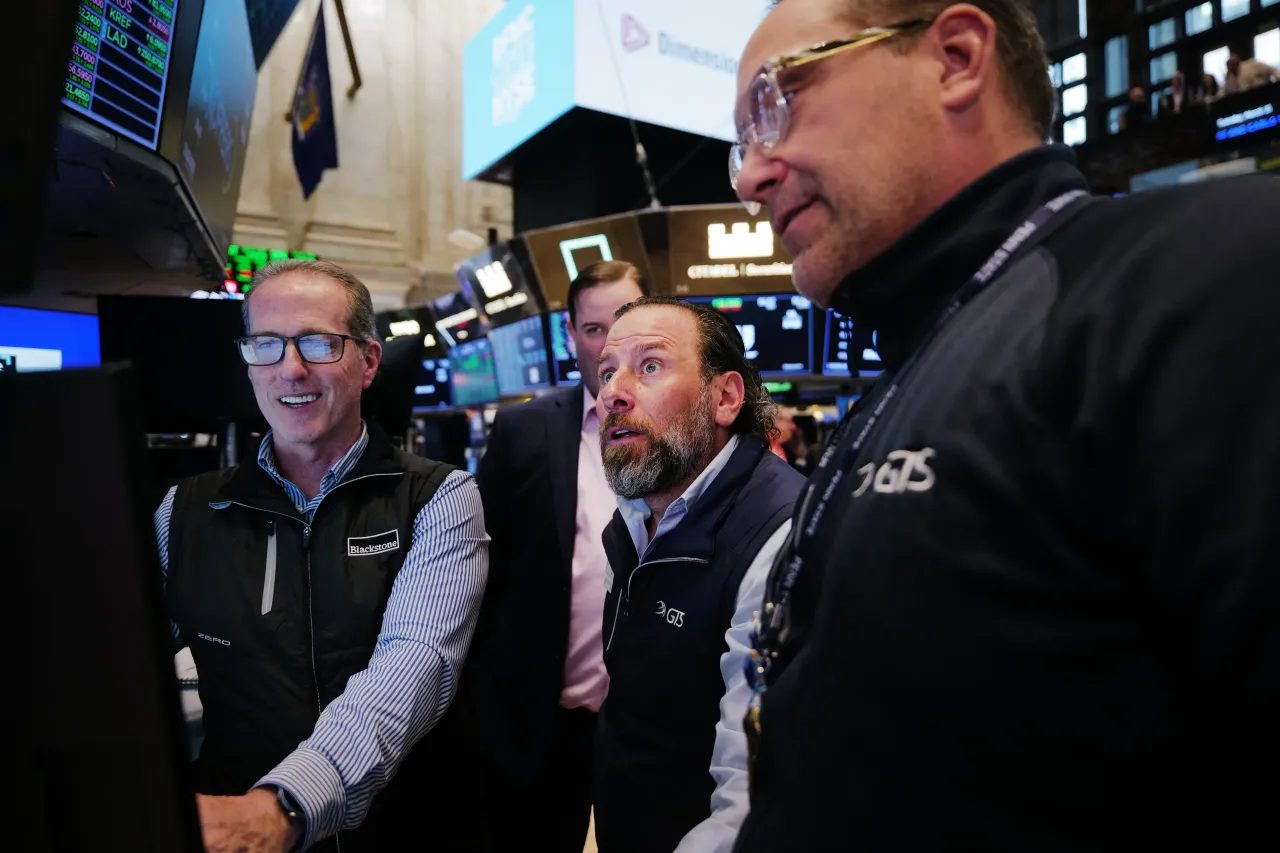
Technology shares rebounded sharply on Monday, giving the Nasdaq 100 its best day in nearly a month after a week that punished many of the market’s most crowded AI trades. Amazon, Apple and Palantir rose, while CoreWeave and other volatile infrastructure names recovered part of their recent losses. The move was broad enough to cool fears that the prior week’s decline had become a disorderly exit.
One session does not erase the damage. The Nasdaq Composite had fallen about 4.5% in the previous week, and semiconductor shares had endured a nine-session losing streak. CoreWeave, a focal point in the debate over AI capital spending, had dropped nearly 12% on Friday alone. Monday’s gains therefore looked partly like short-covering and bargain hunting after a rapid repricing.
The more durable support came from earnings. According to LSEG figures cited by CNBC, 47 S&P 500 companies had reported by Monday morning and 85% had beaten earnings estimates. Blended earnings growth was running near 29%. That is a strong start, but it also explains why investors are unforgiving: valuations embed continued profit growth, especially among the largest technology companies.
The key question is whether the rebound can move beyond a handful of megacaps and speculative AI names. A healthier recovery would combine stronger market breadth with company results that validate capital spending. For Amazon and other hyperscalers, investors need evidence that cloud and AI revenue can scale alongside depreciation and data-center costs. For infrastructure providers such as CoreWeave, financing costs and the pace of capacity delivery matter as much as booked demand.
The day’s rally is therefore best read as a reset in positioning, not proof that the AI correction has ended. Upcoming megacap earnings can support the market if revenue, margins and guidance justify expectations. They can also expose the same asymmetry that drove the selloff: when forecasts are already optimistic, even solid results may not be enough.
Latest comments