
USDC Moved $36 Trillion, but Circle's Economics Still Favor Partners
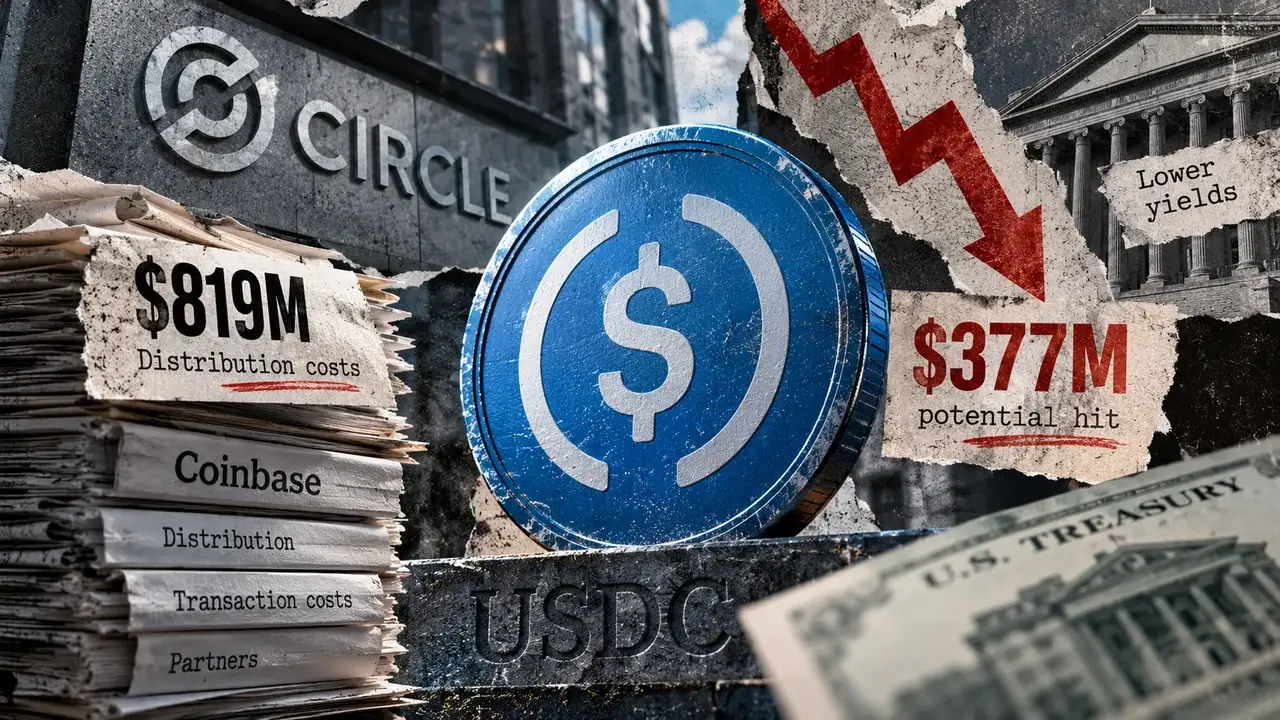
Circle says USDC processed more than $36 trillion in first-half transactions, while partner payments and operating investment left about seven cents of net profit per revenue dollar.
USDC processed more than $36 trillion of transactions in the first half of 2026, but that enormous payment volume did not translate directly into equally large revenue for Circle. The company reported about $1.4 billion of first-half revenue, a reminder that stablecoin transaction value is not the same as issuer sales.
Circle says approximately $819 million, or 59 cents of every revenue dollar, went to distribution partners and transaction costs. It spent another $473 million, about 34 cents per dollar, on licenses, banking, compliance, liquidity, product development and blockchain integrations. That left roughly seven cents of net profit per dollar of revenue.
The largest partner relationship is Coinbase. Circle said Coinbase held an average $20 billion of USDC in its products during the second quarter, up 44% from a year earlier. The arrangement helps distribute USDC and increases balances that generate reserve income, but it also means a substantial share of the economics goes to a partner with meaningful bargaining power.
The comparison between $36 trillion of transaction value and $1.4 billion of revenue should not be read as a conventional payment take rate. The same USDC can move many times, and most transfers do not create a fee for Circle. Revenue is driven mainly by income on reserve assets, along with services and transaction-related activities. Interest rates, circulating supply, partner terms and the mix of reserve assets therefore matter more to earnings than headline blockchain volume alone.
Circle's second-quarter materials reported USDC circulation of $73.3 billion and quarterly transaction volume of $14.8 trillion. Those figures support the scale of the network, while the first-half cost breakdown exposes the tension in the model: distribution expands adoption, yet the partners that deliver that adoption claim a large part of the value.
For CRCL investors, seven cents of profit per revenue dollar is neither automatically weak nor permanently fixed. It reflects a period of aggressive investment and current commercial agreements. The central question is whether USDC circulation and services can grow faster than partner payments and operating costs, especially if interest rates decline and reserve income becomes less generous.
Latest comments