


 Be The Investor Research
Leveraged Funds Add 1,669 BTC to Net Bitcoin Futures Shorts Ahead of the Fed
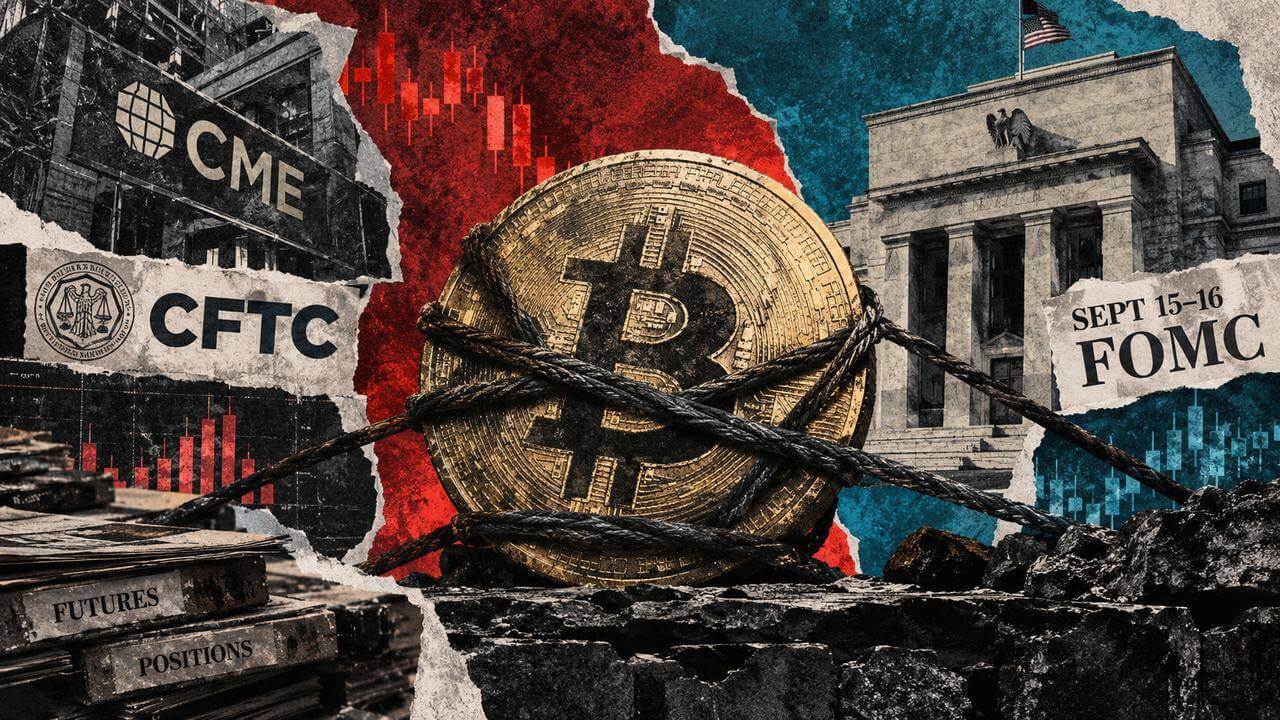
Leveraged funds increased their combined net short across regulated Bitcoin futures markets by 1,668 BTC in the week to September 8. The positioning looks bearish at first glance, but CFTC data cannot separate directional shorts from basis-trade hedges.
Leveraged funds increased their combined net short across four regulated Bitcoin futures markets by approximately 1,668 BTC in the week ending September 8.
The supplied source calculates the combined position at 39,876 BTC net short, up from 38,208 BTC a week earlier.
Most of the change came from CME’s standard five-Bitcoin contract.
CFTC data show leveraged funds added 888 short contracts and 616 long contracts in that market. The net change equals 272 contracts, or 1,360 BTC, accounting for most of the weekly increase described by the source.
That sounds clearly bearish, but the interpretation is more complicated.
The CFTC classifies traders by business type, not by the purpose of each individual position. Leveraged funds can include hedge funds, commodity trading advisers and other money managers using futures for directional bets, arbitrage or hedging.
A short futures position can therefore sit against a long spot Bitcoin or spot ETF position as part of a basis trade.
That is why rising shorts should not automatically be read as a forecast of falling Bitcoin prices.
The more useful signal is the combination of positioning, basis spreads and spot-market behavior.
If leveraged-fund shorts rise while ETF inflows remain strong, the positioning may reflect market-neutral arbitrage.
If shorts rise at the same time ETF flows weaken and spot Bitcoin breaks support, the bearish interpretation becomes more credible.
The timing is also important because the Federal Reserve meeting can change both interest-rate expectations and the economics of basis trades.
Higher yields and tighter financial conditions can reduce appetite for leveraged crypto positions even when the trade is market-neutral.
What investors should watch: CME futures basis, spot ETF flows, changes in leveraged-fund long positions, Bitcoin’s reaction to the Fed and whether the net short continues expanding for several reporting weeks.
BTI’s bottom line: the additional 1,668 BTC of net short exposure is worth watching, but it is not proof that hedge funds are making a simple bearish Bitcoin bet. The CFTC data become more informative when combined with ETF flows and futures-basis behavior.
Continue your BTC research
Related News

BlackRock's Bitcoin Transfer Looks Like Settlement, Not a New Sell Signal
Wallets labeled as BlackRock-linked sent about $262 million of bitcoin to Coinbase Prime after a large ETF outflow. The close match suggests redemption settlement, though public data cannot prove a one-to-one link.
WisdomTree Withdrew Its XRP Fund Filing, Ending a Claimed Catalyst
SEC records show WisdomTree withdrew its XRP fund registration in January 2026. Reported ETF inflows remain relevant, but no pending WisdomTree approval should anchor the investment case.

Strive Reaches 43,000 Bitcoin as a $1 Billion SATS Plan Raises the Cost
Strive added 6,182 Bitcoin and opened a $1 billion at-the-market program for 15% preferred stock. The financing expands buying capacity but creates a large recurring cash claim.

BitMine and Strive Keep Buying Crypto as Strategy Pauses
BitMine added 10,452 Ether and Strive bought 6,182 Bitcoin during a risk-off week, while Strategy favored a $204.9 million preferred-share repurchase over another Bitcoin purchase.
Bitcoin's $80,000 Test Is About ETF Cost Basis, Not a Magic Line
Bitcoin's break below $80,000 put recent ETF buyers near losses after a $635.5 million outflow. Leverage and thin weekend trading make $77,600 a reference, not a forecast.

TRON's Usage, Hyperliquid's Buybacks and Solana's Upgrade Shape the Race
TRON and Hyperliquid need roughly 30% rallies to revisit their highs, while Solana needs about 190%. The distance matters, but network use, buybacks and upgrade execution matter more.
BitMine’s Ether Hoard Reaches 4.95% of Supply

BitMine Immersion Technologies bought another 10,452 Ether during the week ended October 25, bringing its holdings to 6,051,933 tokens. The company says that equals 4.95% of Ethereum’s 122.2 million-token supply, leaving it close to its stated 5% ceiling.
At the reference price of $2,356 per Ether used in BitMine’s release, the Ether position was worth about $14.3 billion. The company reported total crypto, cash, marketable securities and other investments of $15 billion, including $514 million of cash and marketable securities, 215 bitcoin, a $180 million stake in Beast Industries and a $76 million stake in Eightco.
The scale creates both an income stream and a large market exposure. BitMine said 5,227,037 Ether, about 86% of its holdings, was staked as of October 25. Using a 2.58% seven-day yield, management projected annualized staking revenue of roughly $318 million on the current staked balance. It estimated about $368 million if the full Ether position were staked.
Those are forward-looking estimates, not contracted revenue. Staking yields can change, and rewards are exposed to Ethereum protocol rules, validator performance, slashing risk and the price of Ether. A 10% move in the token’s price would change the marked value of the 6.05 million-token position by roughly $1.43 billion at the company’s reference price, far more than the projected annual staking revenue.
BitMine also repurchased 2.04 million of its own shares during the latest week at an average price of $22.48. It said 2026 buybacks reached 22.9 million shares at an average of $17.48, for a total of $399.6 million. Buybacks can increase each remaining share’s claim on the treasury, but the result depends on the purchase price, funding source and any future issuance.
The company’s 5% target is now the immediate milestone. Management has said the accumulation program is meant to stop at that level, so reaching it would shift the investor debate from acquisition pace to how BitMine finances, stakes and governs the position. It would also make the stock’s sensitivity to Ether prices even more direct.
Investors should track the actual token count, staked percentage, cash balance, share count and realized staking revenue. The latest purchase is incremental, but the concentration is not: BitMine has built a treasury whose value can move by billions of dollars as Ether prices change.
Canada's Draft Stablecoin Rules Ban Yield and Tighten Reserves

Canada has published draft rules for fiat-backed stablecoins that would prohibit issuers from paying yield for holding the tokens, require fully backed reserves and set a three-business-day redemption deadline. The proposal is open for public comment through December 23 and is not yet in force.
The regulations would implement parts of Canada's Stablecoin Act. Issuers would need to register with the Bank of Canada and maintain reserve assets with a daily market value at least equal to the face value of their outstanding stablecoins. The assets must meet liquidity and quality standards, and non-bank issuers would generally need to hold reserves with eligible Canadian financial institutions.
The proposed yield ban is broader than a simple prohibition on an issuer paying interest directly. It also covers indirect arrangements in which another party rewards customers for holding a stablecoin. Rewards tied to transactions would remain allowed. That distinction is designed to keep payment tokens from competing with bank deposits primarily as interest-bearing savings products.
Redemption terms are equally important. Holders would have to receive conventional currency within three business days, and redemption fees could not exceed 1%. These requirements address two practical risks: whether backing assets are actually available when customers want cash and whether fees make redemption uneconomic during market stress.
The Stablecoin Act received royal assent on March 26, 2026, but the relevant provisions have not yet taken effect. The draft regulations are part of the process needed to make the framework operational. That means platforms and issuers should not treat the proposal as final law. Consultation responses could change the details before implementation.
The federal proposal may also intersect with provincial securities permissions. Some Canadian platforms have offered stablecoin rewards under provincial conditions, including risk disclosures. A federal ban on holding-based yield could narrow those programs even when a provincial regulator has permitted them. The exact transition will depend on the final regulations and their effective date.
For the market, the draft trades yield flexibility for clearer reserve and redemption protections. Issuers would face higher compliance and custody costs, while users would gain a more standardized claim on backing assets. Banks may benefit if the yield ban limits competition for deposits, but the proposal does not eliminate stablecoins as payment tools. It allows transaction-linked rewards and creates a registration path rather than prohibiting issuance.
The December 23 deadline is therefore more than a procedural date. It is the industry's opportunity to challenge the treatment of indirect rewards, reserve custody and redemption mechanics before the rules are finalized.
Issuer Objections Narrow OKXICE's Tokenized Stock Launch

Wells Fargo, Arm Holdings and Intuit are among six more companies that have blocked OKXICE from offering tokenized versions of their shares, bringing the disclosed objection count to 22. Reuters reported the additions on October 23 after reviewing a regulatory document. The companies did not explain their decisions, so the objections should not be read as a verdict on every form of stock tokenization.
The immediate consequence is narrower than the headlines suggest. The objections apply to OKXICE, the planned venue jointly owned by Intercontinental Exchange and crypto exchange OKX. They do not prevent the same issuers from supporting another tokenization structure later. Still, 22 objections against a proposed list of 63 stocks show that issuer consent can materially shrink a venue before trading begins.
How the SEC framework gives issuers control
The Securities and Exchange Commission approved a five-year innovation exemption on September 17 for qualifying tokenized securities venues. The exemption permits limited trading of tokenized U.S. listed stocks in a permissioned environment while the SEC studies the market structure. Under the process described in the OKXICE disclosures, a venue must notify an issuer before listing a third-party token tied to its shares and wait at least 30 calendar days. A timely written objection stops that token from trading on the venue.
That safeguard has produced a rapid series of opt-outs. OKXICE disclosed nine objectors on October 15, then 16 on October 19. The earlier list included Broadcom, Verizon, UnitedHealth, Microsoft, Alphabet and Goldman Sachs. The latest Reuters report added Wells Fargo, Arm and Intuit among six more companies, although the other three were not named publicly in the reporting reviewed for this article.
The venue's proposed design also matters. OKXICE plans to use permissioned Uniswap v4 pools on XLayer, with stock tokens paired against stablecoins. Only wallets holding the venue's nontransferable access token would be eligible to trade. The venue has not announced a launch date, and its disclosures state that it is not registered with the SEC as a conventional exchange for these activities.
What investors can conclude
Tokenization advocates argue that blockchain-based shares could trade around the clock and settle faster. The objections do not disprove those benefits. They do show that technological permission and regulatory permission are not the same as commercial acceptance.
For Intercontinental Exchange, the development is strategically relevant but not yet financially measurable. The venture can still launch with issuers that do not object, including several large technology companies listed in the October 19 notice. The unresolved question is whether a smaller roster attracts enough liquidity to make 24-hour trading useful. Until OKXICE names a launch date, publishes an updated issuer list and shows trading economics, the objection count is evidence of adoption friction rather than a quantified earnings risk.
What 10 ETH Could Be Worth in 2030, Without Pretending It Is a Forecast

A prediction about what 10 ether will be worth in 2030 can sound precise while hiding the assumptions that do all the work. The useful exercise is to turn price targets into valuation scenarios and ask what would need to change for each one to become credible.
At $1,500 per ETH, a 10-coin holding would be worth $15,000. At $5,000, it would be worth $50,000. At $10,000, it would be worth $100,000. Using the source article's snapshot of 122.2 million ETH in circulation, those prices imply network values of roughly $183.3 billion, $611 billion and $1.22 trillion, respectively.
Those market-cap figures are only snapshots because ether's supply is not fixed. Ethereum issues new ETH to validators who help secure the network, while its fee mechanism burns a portion of transaction fees. The official Ethereum documentation explains that net supply can grow or shrink depending on the relationship between issuance and burning. A 2030 price therefore cannot be evaluated with today's supply count alone.
Demand is just as uncertain. U.S. spot ether exchange-traded funds create a regulated route for investors to obtain exposure, but their flows can reverse. SoSoValue recorded $110.5 million of net outflows on October 22 and about $14.57 billion of net assets at that date. One day's flow says little about 2030, but it illustrates why ETF adoption is a variable rather than a one-way source of demand.
Ethereum's role as infrastructure for tokenized assets could matter more over several years. BlackRock and JPMorgan Asset Management have both published research on tokenization and digital-asset infrastructure, supporting the broader case that financial assets may increasingly use blockchain rails. That does not prove that activity will accrue value to ETH. Investors still need to distinguish growth in tokenized products from fees paid on Ethereum, and fees from the amount of ETH ultimately burned.
The $5,000 scenario requires more than a return to a previous nominal high. It requires enough sustained demand to support an implied network value near $611 billion at the assumed supply. The $10,000 case asks investors to justify a valuation above $1.2 trillion, while also accepting regulatory, competition, technology and market-cycle risks. The $1,500 case shows that network use can expand while the asset still disappoints if demand, liquidity or risk appetite weakens.
No single scenario deserves the label "most realistic" without an explicit probability and evidence. A more disciplined approach is to update the valuation as supply changes, ETF flows accumulate and Ethereum's share of tokenized settlement becomes measurable. The arithmetic is simple; the investment judgment lies in deciding which economic activity will create durable demand for ETH rather than merely use the network for a moment.
Strategy's MSCI Risk Exposes a Thin Bitcoin Premium

Strategy's 13% decline since September 22 is not just another Bitcoin move. A new MSCI eligibility rule threatens the stock's place in global indexes, and that matters because Strategy relies on access to equity markets to increase Bitcoin per common share.
Reuters reported that MSCI announced the rule on October 15 and will exclude non-operating companies from its Global Investable Market Indexes effective November 30. The final affected-company list is due November 11. Strategy is among the companies at risk, but removal was not yet final when the source article was published.
The immediate passive-flow estimate may be smaller than the headline suggests. TIKR said MSCI-tracking funds held about 13 million Strategy shares, less than one day of trading volume. Strategy has separately said such funds own about 3.1% of its basic shares. The larger issue is whether exclusion weakens a shareholder base that helps sustain the company's market-value premium over its net Bitcoin assets.
That premium is the engine of Strategy's model. When common shares trade above net Bitcoin value after debt and preferred claims, issuing stock to buy Bitcoin can increase Bitcoin exposure per share. TIKR put the company's modified net asset value multiple at about 1.07 in August, leaving a thin cushion. A lower premium makes common issuance less productive even if index-related selling is absorbed quickly.
Recent capital allocation shows the constraint. Strategy's October 12 SEC filing said it sold 125,183 common shares for $21.0 million of net proceeds in the week ended October 11 and bought 250 Bitcoin. It also repurchased $192.4 million of STRC preferred stock. The October 19 filing said Strategy sold another 140,872 common shares for $22.0 million, bought 267 Bitcoin for $22.1 million and repurchased 1,938,780 STRC shares for $193.1 million.
Across those two weeks, the company spent about $385.5 million on STRC repurchases and $43.1 million on 517 Bitcoin. That is nearly nine dollars of preferred-stock repurchases for every dollar of Bitcoin purchases. The board also increased the preferred repurchase authorization from $2 billion to $3 billion on October 19.
The cash categories should not be blended. Strategy's filing defines its dollar reserve as money intended to support preferred dividends and debt interest, while separate dollar cash can fund Bitcoin, capital management and other corporate uses. As of October 18, the reserve held $4.83 billion and available dollar cash held $447.3 million. During the week, Strategy used $45.5 million of the reserve for preferred dividends and $193.1 million of available cash for STRC repurchases.
That split shows why a large headline cash balance does not all serve the same purpose. It also makes the October 28 shareholder vote on permitting daily dividends for four preferred series relevant to future cash administration. Strategy had separately estimated a $20.91 billion third-quarter digital-asset gain, but that accounting gain does not create spendable cash.
The key dates are November 11 for MSCI's list and November 30 for the rule's effective date. The investment question is not simply whether passive funds sell. It is whether Strategy can preserve enough premium and flexible cash to finance Bitcoin accumulation after servicing and supporting a much larger capital structure.
Latest comments