



 Be The Investor Research
UK Grid Inquiry Clears Cover-Up Claim but Flags Culture Risk

An independent inquiry found no evidence that UK grid executives distorted operational decisions, but it identified serious cultural and governance problems during June’s heatwave and system stress.
An independent inquiry into Britain’s electricity system operator found no evidence that executives interfered with control-room decisions or ordered staff to conceal records. It did, however, identify significant cultural, governance and control problems that could matter for system resilience.
The review by Eversheds Sutherland followed whistleblower claims that National Energy System Operator executives played down blackout risks during a June heatwave. Control-room staff had raised concerns about stress, operational pressure and whether senior management understood conditions on the frontline.
June’s heatwave tested the system from several directions at once. Electricity demand rose as air conditioning use increased, a high-pressure weather pattern reduced wind generation, and gas and nuclear plants suffered unplanned outages across Europe. Britain required emergency assistance from neighboring systems on several occasions as grid frequency moved below normal operating limits.
The investigators did not substantiate allegations of improper corporate-affairs influence over operational decisions. They did find that staff felt concerns went largely unheard and that management had not adequately recognized the pressure on engineers responsible for balancing the system.
NESO Chief Executive Fintan Slye said the operator would act on the recommendations and work with unions to improve how employees raise concerns. Ofgem described the findings as important and concerning.
The regulatory process is not finished. Ofgem is conducting a separate technical review of system operations during the week beginning June 22 and said findings would be published no later than March 31, 2027. The regulator could open an enforcement investigation if it finds breaches of market obligations or evidence that cultural failures affected security or consumer costs.
For investors in UK power infrastructure, the report is not proof that the grid was mismanaged. It is evidence that organizational risk deserves the same attention as generation capacity and transmission investment. A system with more weather-dependent power needs staff who can escalate operational concerns quickly and without fear. The next Ofgem report will determine whether the documented culture problems remained internal or influenced real-world reliability and costs.
Related News

A 1987-Scale Crash Would Hit Today's 20% Circuit Breaker
Applying Black Monday's percentage loss to today's market produces a dramatic dollar figure, but modern circuit breakers would halt trading at a 20% decline and the calculation is a stress test, not a forecast.

A 13.5% Income Portfolio Comes With Concentrated Risk
Six high-yield securities could produce about $10,159 a year on $75,000 at recent distributions, but the largest payouts come from leveraged mortgage REITs and a BDC that has already cut its dividend.

MARA's 1,000 Bitcoin Transfer Is Not Proof of a Sale
MARA moved 1,000 Bitcoin to exchanges, but wallet transfers alone cannot distinguish a sale from collateral, lending or hedging. The company's filings show that Bitcoin is now both a treasury asset and a funding source.

JPM Coin Moves to Ethereum, Expanding Institutional Reach
JPMorgan is bringing its bank-backed deposit token to Ethereum after launching it on Base, giving institutional clients another network for round-the-clock settlement while keeping the claim tied to bank deposits.

ARK's $4,400 Tesla Target Is Mostly a Robotaxi Bet
ARK's 2031 Tesla model assigns most enterprise value to robotaxis and assumes millions of vehicles at scale, making regulation, safety, utilization and unit economics more important than today's car deliveries.

HPE's Growth Surge Comes With a Durability Question
HPE's reported networking and server growth reflects AI demand and the Juniper acquisition, but investors must separate acquisition-driven gains from organic growth and watch whether margins hold after the buildout slows.
Falling AI Prices Put a Return Test on the Spending Boom

Bank of America is asking a harder question than whether artificial intelligence usage will grow. Its warning is that competition can make a technology widely successful while reducing the returns earned by the companies that financed its infrastructure.
According to a client note summarized by InvestorsHub, consensus forecasts for hyperscaler capital spending over the next year have risen from about $330 billion in early 2025 to roughly $1 trillion. The bank compares that amount, around 3% of U.S. gross domestic product, with earlier investment booms in railroads and technology. Such comparisons do not predict an identical outcome, but they highlight the risk that capacity can expand faster than profitable demand.
Pricing is central to the argument. The note says average AI token prices have fallen by about half since the summer as model competition intensified. Cheaper inference can encourage much greater use, a version of the economic effect known as Jevons paradox. Yet rising token volume does not guarantee that customer spending or provider profit will rise at the same pace.
Bank of America cited business-spending data that softened even as token usage increased. That divergence is an early signal rather than conclusive evidence. The underlying data cover only part of the market, and lower prices can take time to unlock new applications.
The investor implication reaches across chip designers, data-center operators, utilities and cloud providers. Each group can benefit from expanding workloads, but the value captured depends on pricing power, utilization and the cost of capital. A server that remains full can still earn a disappointing return if service prices fall too quickly.
The next phase of the AI cycle should therefore be judged by revenue and cash returns, not only by chips installed or tokens processed. Sustained cloud growth and improving utilization would answer the bank's concern. Slowing business spending alongside lower prices would suggest that the infrastructure boom is creating more computing capacity than near-term economics can support.
Salesforce's 2030 Target Depends on AI Revenue, Not a $700 Guess
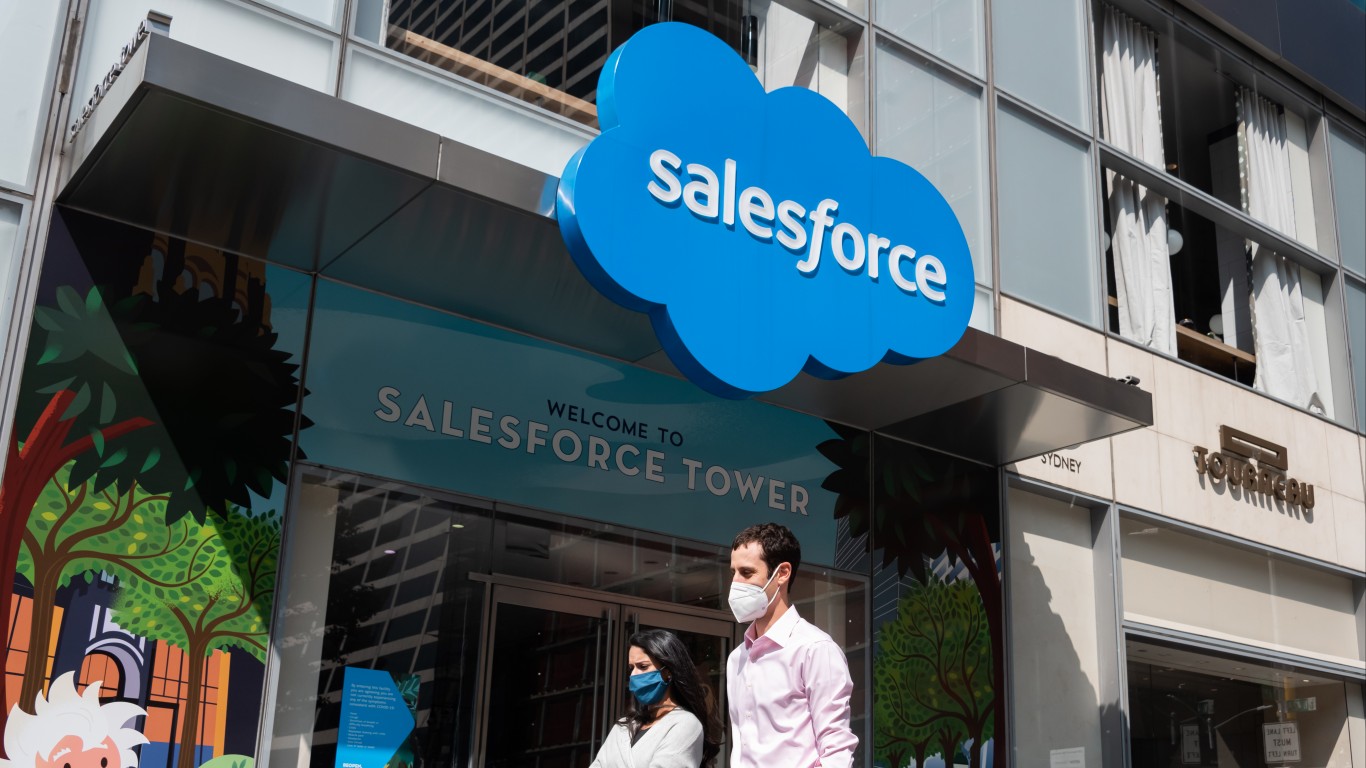
Salesforce has supplied investors with an operating target for 2030. The company aims to exceed $60 billion of annual revenue, excluding Informatica, and expects organic revenue to compound at more than 10% from fiscal 2026 through fiscal 2030. That target is more useful than a speculative $700 share-price forecast because it can be tested against reported results.
The second quarter of fiscal 2027 showed why the bull case exists. Revenue rose 11% to $11.3 billion. Remaining performance obligations reached $66.3 billion, while combined Agentforce and Data 360 annual recurring revenue approached $3.9 billion, up more than 210%. Agentforce alone exceeded $1.5 billion of annual recurring revenue.
The open question is whether AI agents add consumption revenue or reduce the number of paid software seats faster than Salesforce can replace them. The company is moving toward usage-based products, data services and premium editions, but those businesses must become large enough to protect growth in its established sales and service clouds.
Profit quality also matters. Salesforce reported a 20.5% GAAP operating margin and a 34.1% non-GAAP margin in the quarter. Strategic investment gains can make per-share earnings volatile, so cash flow and operating profit provide cleaner evidence of core progress.
A hypothetical $700 share price by 2030 would require more than revenue growth. It would depend on the share count, earnings per share and the valuation multiple investors are willing to pay at that time. Small changes in those assumptions produce very different outcomes.
The practical case is simpler. Salesforce needs to sustain double-digit organic growth, turn Agentforce adoption into recurring revenue and keep expanding margins without starving product development. If those pieces hold, the fiscal 2030 revenue target can support meaningful earnings growth. If AI weakens seat economics or Agentforce adoption stalls, a low forward multiple may reflect a real structural risk rather than an overlooked bargain.
Amazon's $496 Billion Backlog Turns Power Into the Constraint

Amazon Web Services ended the second quarter with $496 billion of contracted backlog, up from $364 billion three months earlier. That is powerful evidence of demand, but it also reveals the constraint on Amazon's largest growth opportunity: much of the business cannot become revenue until new data centers are powered and equipped.
AWS revenue rose 37% to $42.2 billion, its fastest growth in 18 quarters, while operating income reached $16.6 billion. Amazon said demand still exceeded available capacity and raised its 2026 capital-spending plan to about $220 billion, partly because of higher memory costs.
Backlog is not the same as cash in the bank. It represents contracted work to be delivered over time and can depend on Amazon making capacity available. Long contracts improve visibility, but they also lock in commercial terms while the cost of power, memory, accelerators and construction can move.
That tension explains why the opportunity is unusually large and unusually expensive. Amazon can use its balance sheet, custom Trainium chips and global infrastructure experience to build faster than smaller rivals. It can also spread fixed costs across a broad customer base. Yet the investment arrives before the revenue, which has pushed trailing free cash flow below its year-earlier level and increased the consequences of delays.
The most important investor question is therefore not whether customers want AI computing. The backlog already answers that. It is whether AWS can bring capacity online quickly enough and at returns that justify the spending.
Quarterly progress should be visible in four places: AWS growth, operating margin, backlog conversion and cash capital expenditure. If revenue and operating profit scale with the buildout, the $496 billion backlog is a durable advantage. If power bottlenecks or rising component costs slow delivery, the same backlog can expose how much capital Amazon must commit before customers can use what they ordered.
Lilly's $1.1 Billion Metis Deal Starts With a Much Smaller Check

Eli Lilly's collaboration with Metis TechBio is being described as a deal worth up to $1.1 billion. The phrase "up to" does most of the work. Metis is receiving an upfront payment in the low tens of millions of dollars, while the much larger balance depends on development, regulatory and commercial milestones that may take years to reach or may never be paid.
The research partnership focuses on lipid nanoparticles, the small fat-based carriers used to move genetic medicines into cells. Metis will use an artificial-intelligence platform to design ionizable lipids and improve where those particles travel in the body. Today's delivery systems often accumulate in the liver, so reliable targeting of other tissues could broaden the range of diseases addressed by RNA and other genetic therapies.
The companies did not name a drug candidate, disclose a clinical timeline or estimate an effect on Lilly's 2026 earnings. Metis can also receive tiered single-digit royalties on annual net sales of products that emerge from the work.
For Lilly, the economics resemble an option. The upfront cost is small relative to the company's research budget, while milestone payments rise only if the technology advances. That limits near-term financial exposure but also means investors should not treat the full $1.1 billion as committed spending or as evidence of a product close to market.
The strategic value is the chance to solve a platform problem. Better tissue targeting could support several future programs rather than one medicine, which is why delivery technology can matter even before a lead asset is selected.
The next meaningful evidence will be preclinical performance, selection of a development candidate and disclosure of the tissues or disease areas being pursued. Until then, the collaboration expands Lilly's research toolkit, but it is too early to assign material product revenue to the headline milestone figure.
Mounjaro and Zepbound Drive 65% of Lilly Revenue

Mounjaro and Zepbound generated about $14.9 billion of Eli Lilly's $23.0 billion in second-quarter 2026 revenue. That puts roughly 65% of the company's sales behind two medicines built on the same incretin franchise, a concentration that explains both Lilly's growth and its main operating risk.
Demand remains powerful. Lilly reported that second-quarter revenue rose 48%, led by the two products, while volume growth more than offset lower realized prices. The company also raised its full-year outlook. Those figures show that concentration is not currently stopping growth.
The question is how long prescription volume can outrun price pressure. In the United States, rebates, discounts and broader insurance access can reduce the net price Lilly receives even when list prices remain high. More coverage can expand the treated population, but it also strengthens the negotiating leverage of large payers. Competition from Novo Nordisk and future obesity drugs adds another constraint.
Concentration also works in Lilly's favor when manufacturing expands. Each additional dose can spread fixed research, production and commercial costs over a larger sales base. The problem is that a manufacturing disruption, safety concern, reimbursement change or stronger rival could affect a majority of revenue at once.
Lilly has other growth engines in oncology, immunology and neuroscience, and it is investing heavily in new medicines. For now, however, those businesses do not match the absolute scale of Mounjaro and Zepbound.
Investors should focus less on a single headline sales number and more on three moving parts: prescription volume, net realized price and manufacturing capacity. If volume growth stays ahead of price erosion, the franchise can keep expanding. If pricing falls faster or market share slips, Lilly's valuation leaves less room for disappointment because so much of the earnings story runs through the same two products.
Latest comments