



BlackRock’s $1 Billion Staking Ethereum ETF Still Trails ETHA’s $9 Billion Liquidity Advantage
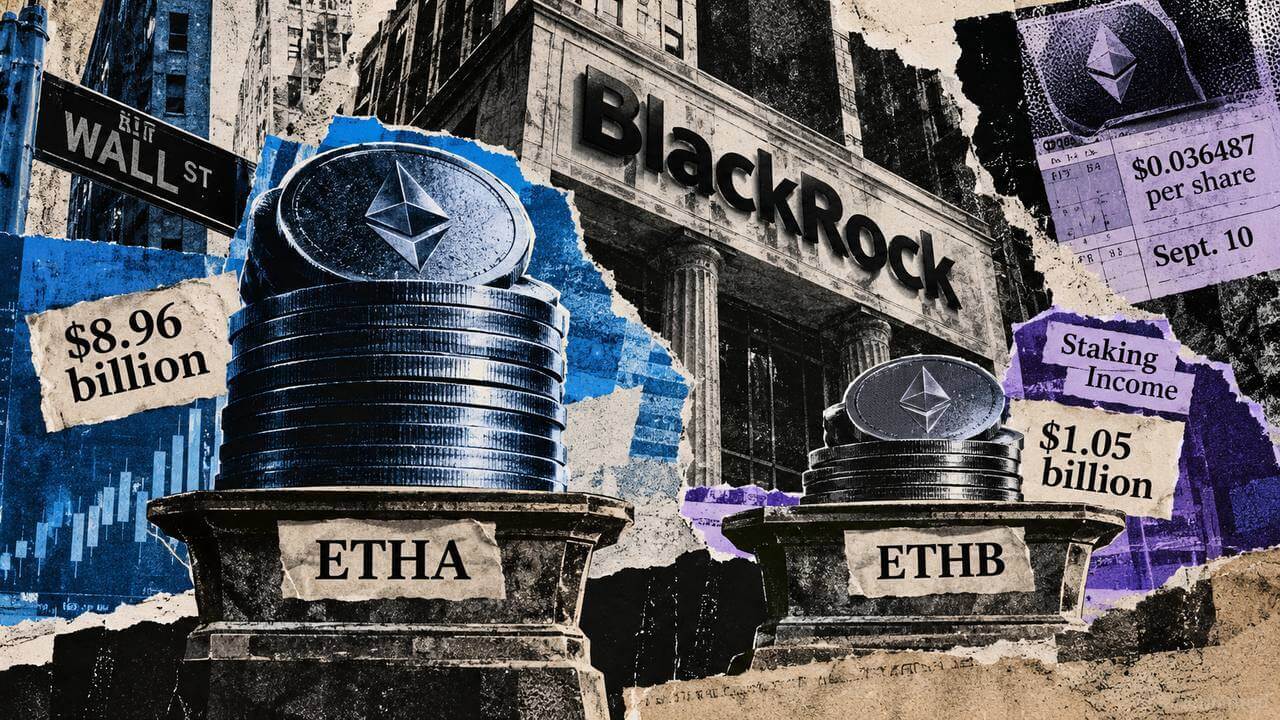
BlackRock’s ETHB has reached about $1.05 billion in assets and pays staking income, but ETHA still holds roughly $8.96 billion and trades at far higher volume. Liquidity, not yield alone, remains the dominant institutional preference.
BlackRock’s staking Ethereum ETF has crossed the $1 billion mark, but investors still overwhelmingly prefer the firm’s original non-staking Ethereum fund.
The supplied source says the iShares Staked Ethereum Trust ETF, ETHB, held about $1.05 billion in net assets as of September 11.
The older iShares Ethereum Trust ETF, ETHA, held approximately $8.96 billion.
Trading liquidity shows an even larger gap.
ETHA generated an estimated $1.86 billion of share turnover in one session, roughly 30 times ETHB’s $61.8 million.
Large institutional investors care about execution costs, market depth and the ability to enter or exit positions without moving price.
ETHB has an economic feature ETHA does not: staking income.
The source says ETHB distributed $0.036487 per share in September and had approximately 75.85% of its ether staked.
The fund also charges a 0.25% annual sponsor fee, temporarily reduced to 0.12% on the first $2.5 billion for a limited period, plus a 10% fee on gross staking consideration.
That means investors receive staking economics only after an additional layer of fees and operational complexity.
ETHB also needs to keep part of its holdings unstaked to manage liquidity and redemptions.
This creates a trade-off.
ETHA offers a simpler and more liquid vehicle.
ETHB offers incremental yield but introduces staking exit times, distribution decisions and another fee layer.
The early data suggest institutions are not willing to abandon liquidity simply to capture staking income.
On September 11, ETHA attracted $148.8 million of net inflows versus $18.3 million for ETHB.
The comparison is not entirely fair because ETHA has a much longer operating history and more established trading relationships.
ETHB reaching roughly $1 billion still shows meaningful demand for a newer yield-bearing product.
The key question is whether the gap narrows over time.
A real migration would show up as sustained ETHB creations at the same time ETHA begins experiencing redemptions.
The asset gap between ETHA and ETHB also creates network effects. Market makers prefer deeper products because spreads are tighter and institutional orders can be executed with less slippage. That liquidity attracts more volume, which can reinforce the same advantage.
ETHB therefore needs more than yield to close the gap. It must build a consistent creation and redemption base large enough for trading liquidity to become self-sustaining.
Staking income can still become more valuable if Ethereum yields rise or if institutions become more comfortable with the operational structure.
The opposite can also happen. Lower staking rewards, higher exit times or changes in fee economics can reduce the incremental benefit relative to a simple spot fund.
That means ETHB is effectively competing on total after-fee utility, not on the existence of yield alone.
What investors should watch: ETHB asset growth, ETHA redemptions, trading-volume convergence, staking distributions, fee changes and whether institutions begin sacrificing some liquidity for yield-bearing ETH exposure.
BTI’s bottom line: staking is useful, but it has not displaced liquidity as the main institutional priority. ETHA’s nearly $9 billion asset base and much deeper trading volume remain a powerful incumbent advantage.
Continue your ETHA research
Related News

BitMine’s Ether Hoard Reaches 4.95% of Supply
BitMine added 10,452 Ether and now holds 6.05 million tokens, or 4.95% of supply. Its staking income, buybacks and exposure to Ether prices matter more as the company nears its 5% accumulation target.

Franklin's Bitcoin DRIP ETFs Turn Stock Dividends Into Crypto
Franklin Templeton's new FBEQ and FIBT ETFs begin with 5% bitcoin exposure and redirect stock dividends into bitcoin. Low headline fees mask a structure that adds crypto volatility, derivative risk and potential tracking differences.

Record SOXL and TQQQ Inflows Put Triple Leverage to the Test
Investors poured billions into SOXL and TQQQ during an AI selloff. The flows show aggressive dip buying, but daily leverage can magnify losses and path dependence.

QQQM Saves $30 per $100,000, but Switching From QQQ Can Cost More
QQQ and QQQM track the same Nasdaq-100 Index, but QQQM charges three basis points less. Taxes, options liquidity and account type determine whether switching makes sense.
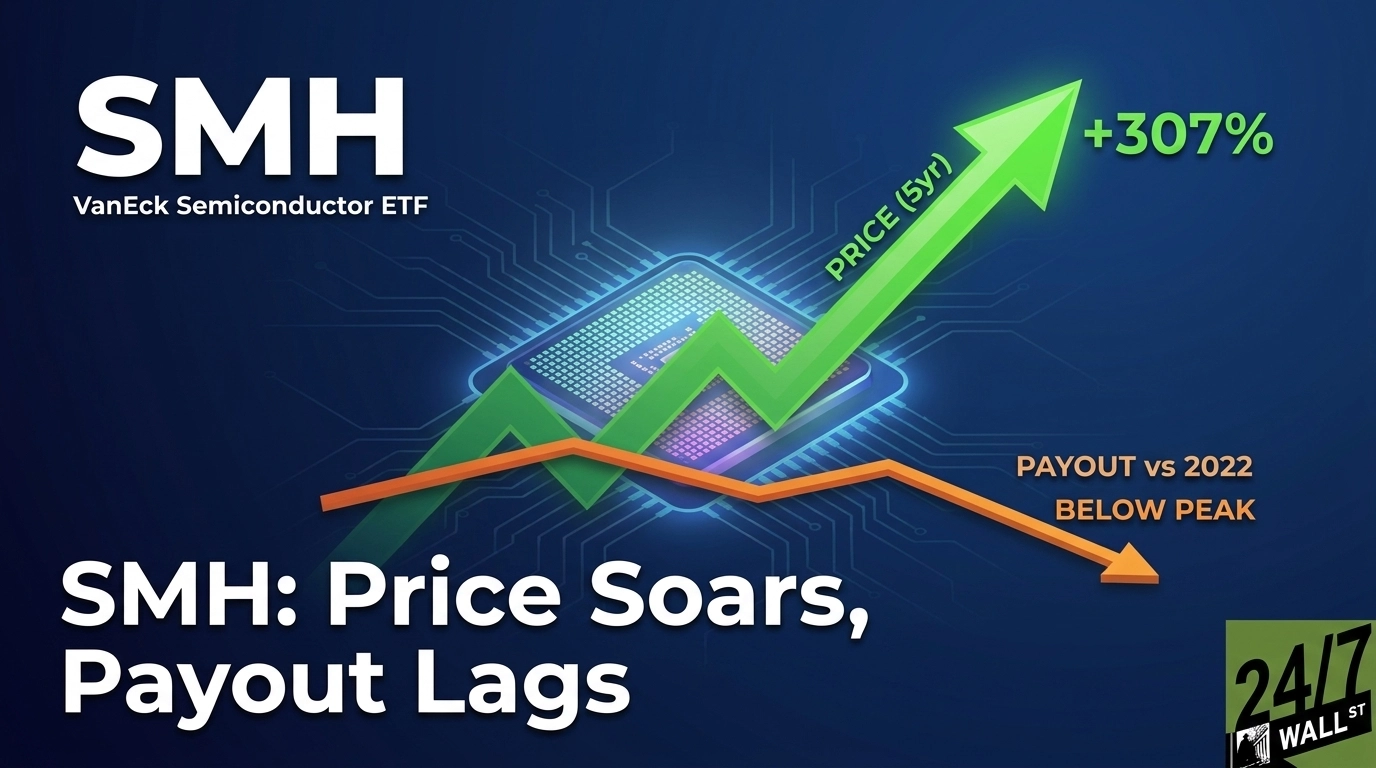
SMH's 0.2% Yield Shows What Semiconductor Investors Are Buying
SMH has delivered strong price gains while its annual distribution remains below its split-adjusted 2022 level. The contrast reflects a concentrated portfolio built for semiconductor growth, not meaningful current income.

Super Micro's 61% Slide Exposes an Unpriced Cost of Indexing
VOO's rules required exposure to Super Micro after its S&P 500 inclusion, before a 61% decline. The damage to a broad fund was small, but the episode shows how index timing works.
Pfizer's November 3 Report Must Separate Pipeline Progress From Decline

Pfizer's November 3 report will test whether newer products can offset the decline of its pandemic-era business. The company has scheduled a third-quarter results call for 10 a.m. Eastern that day, with the performance report due the same morning.
The June quarter provided encouraging operating evidence. Revenue rose 3% as reported to $15.0 billion, or 1% on an operational basis. Excluding Comirnaty and Paxlovid, revenue increased 5% operationally. Products that Pfizer launched or acquired grew 18% operationally, led by medicines including Eliquis, Padcev, the Vyndaqel family and Lorbrena.
Reported and adjusted earnings told different stories. Pfizer posted a reported loss of $0.04 per share after recording $4.3 billion of non-cash intangible-asset impairments, while adjusted diluted earnings were $0.77 per share. The distinction is essential because neither measure should be silently substituted for the other.
Pfizer raised the midpoint of its 2026 revenue guidance to $61.5 billion, within a range of $60.5 billion to $62.5 billion, and kept adjusted diluted earnings guidance at $2.80 to $3.00. That outlook includes a $650 million acquired in-process research and development charge tied to the Innovent transaction, expected to reduce third-quarter adjusted earnings by about $0.10 per share.
The pipeline offers both opportunity and uncertainty. Pfizer's 25-valent pediatric pneumococcal vaccine candidate produced robust immune responses against all 25 target serotypes in Phase 2, including stronger responses against serotype 3 than Prevnar 20. The company said adverse events were balanced between groups and that it identified no related serious adverse events. Phase 3 studies are under way, but the product remains an investigational candidate rather than approved revenue.
The original analysis also cited a disappointing overall-survival result for sigvotatug vedotin in lung cancer. Pfizer's accessible event material confirms the Phase 3 presentation at ESMO, but it did not provide enough primary detail to reproduce the exact survival figures responsibly. Those figures are therefore not repeated here.
The stock's rerating depends on more than meeting a quarterly consensus estimate. Pfizer needs launched and acquired products to sustain double-digit growth, older-product declines to moderate and late-stage programs to demonstrate clinical value. November 3 can clarify the first two points; the pipeline will require separate trial results and regulatory decisions.
OKX-ICE Adds More Stock-Token Objections as Venue Risks Stay Unsettled
IBM, Oracle and Intel are among companies that objected to tokenized versions of their shares trading on the planned OKX-ICE venue, according to Unchained's review of an October 26 public notice. The report put the total number of objecting companies at 26, up from 22 in an earlier version.
The venue's own public page confirms that October 26 is the latest notice and preserves earlier versions. That version history matters because the list has changed repeatedly before launch. The accessible source report says the latest additions also include IonQ and that Moderna, Cisco and Marvell appear among the objectors.
An issuer objection has a defined effect under the temporary SEC exemption described in the notice. When an unaffiliated third party creates the token, the venue must notify the issuer and wait at least 30 calendar days before trading begins. A written objection during that window prevents the token from trading, and the venue must publish the objection within five business days.
OKXICE is a 50-50 joint venture between Intercontinental Exchange Holdings and OKC USA Holding. Its design uses permissioned Uniswap v4 liquidity pools on XLayer. Participants must pass identity and sanctions checks, open an account with the tokenizer and hold a non-transferable permission token in a self-custodied wallet.
The disclosures also show why issuers and investors may be cautious. OKXICE says it is not registered with the SEC for these activities, is not subject to Regulation NMS and does not receive the same fair-access review as a registered exchange or regulated alternative trading system. The notice also says administrators can upgrade contracts, pause pools, change permission lists and withdraw a liquidity provider's assets. Contract changes take effect without a timelock, so users may receive no advance warning.
Those risks do not prove that the venue will fail or that tokenized stocks lack value. They do show that a token representing a public share is not operationally identical to trading that share on a conventional exchange. The objection count is therefore more than a branding dispute: it is a measure of how many issuers are unwilling to accept that structure before unresolved market-protection questions are tested in practice.
Intel's Data Center Rebound Still Depends on a Mostly Internal Foundry
Intel's June-quarter numbers show a business improving faster than its foundry economics. Data Center and AI revenue rose 59% from a year earlier to $6.3 billion, while total Intel Products revenue reached $15.1 billion.
Intel Foundry also reported $5.8 billion of revenue, up 31% year over year, but most of that activity still came from manufacturing for Intel's own product groups. The original analysis put outside-customer revenue at $293 million. Dividing that amount by $5.8 billion gives roughly 5.1%, a BTI calculation that shows how little of the foundry's current scale comes from external clients.
The unit's operating loss was $2.1 billion, although it narrowed by $348 million from the preceding quarter, according to the source analysis. That distinction matters: higher internal foundry revenue does not by itself prove that Intel is building a competitive contract-manufacturing business. External customer volume, process yields and pricing will determine whether the unit can eventually cover its enormous fixed costs.
Intel's consolidated results also require careful reading. The company generated operating profit in the quarter, while its reported net loss was driven heavily by a $12.53 billion mark-to-market loss on escrowed shares recorded below operating profit. That accounting item explains why the net-loss figure looks much worse than the operating business without making the foundry loss disappear.
The next checkpoint is close. Intel has scheduled its third-quarter earnings call for October 29 at 2 p.m. Pacific time. Investors need evidence on three separate questions: whether data center growth is holding, whether Intel Foundry's loss is continuing to narrow and whether external customers are becoming a larger share of foundry revenue.
The stock's large 2026 rally makes those questions more urgent, but price performance is not evidence of foundry traction. Intel can deliver a strong product cycle while still struggling to convert its factories into a durable outside business. The October report will be more persuasive if management provides customer commitments, yield progress and a credible path from internal utilization to external profitability.
Nvidia and TSMC Show the Same AI Boom Through Different Risks
Nvidia and Taiwan Semiconductor Manufacturing are benefiting from the same AI investment cycle, but their latest results reveal different pressure points. Nvidia's fiscal second quarter ended July 26, while TSMC's third quarter ended in September, so the numbers should not be treated as if they cover the same period.
Nvidia reported fiscal second-quarter revenue of $96.2 billion, up 106% from a year earlier. Data Center revenue reached $89.0 billion, up 117%, and gross margin was 75.0%. The company guided fiscal third-quarter revenue to $108.0 billion, plus or minus 2%, while excluding any Data Center compute revenue from China from that outlook.
The scale is impressive, but it also concentrates risk. Nvidia's Form 10-Q says one direct customer represented 16% of quarterly revenue. The company also depends on outside foundries, memory suppliers and system partners to turn demand into delivered systems. Vera Rubin was ramping into full production during the quarter, so execution now includes an unusually fast transition between major platforms.
TSMC's third-quarter revenue rose 41.2% from a year earlier to $46.72 billion. High-performance computing generated 68% of revenue, and the new 2-nanometer process reached 8% of wafer revenue, up from 3% in the second quarter. Gross margin was 66.4%, down 1.3 percentage points sequentially, primarily because of dilution from the initial 2-nanometer ramp.
TSMC expects fourth-quarter revenue of $52.3 billion to $54.3 billion and gross margin of 65% to 67%. It also expects full-year 2026 revenue to grow around 44% in U.S. dollar terms. Those forecasts indicate that advanced-node demand remains strong even as the newest process initially carries higher costs.
The comparison is not simply chip designer versus manufacturer. Nvidia carries platform-transition, supply-chain and customer-concentration risk. TSMC carries factory-ramp, capital-intensity and geographic risk. Nvidia can preserve margins through product mix and system value; TSMC must improve yields and utilization as new capacity matures.
Both businesses are still reporting exceptional growth. The sharper investor question is who absorbs the next increment of cost if memory, packaging or leading-edge wafer supply remains tight. Nvidia's fiscal third-quarter margin and TSMC's 2-nanometer yield progression will provide more useful evidence than a one-month share-price comparison.
Apple Offers iPhone Duo Replacements as Inner Screens Crack

Apple has acknowledged an inner-display problem in a small number of iPhone Duo units only days after the foldable phone reached customers. The company told The Verge that affected owners should contact AppleCare for a replacement.
That response establishes a remedy, but it does not establish the size or cause of the defect. Apple has not published a unit count, a failure rate or a repair timeline. Reports describe cracked screens and bright lines near the hinge, sometimes after the hinge became harder to move, but those customer reports do not show that the problem affects the broader installed base.
The timing is awkward because the Duo is Apple's first foldable iPhone and starts at $1,999. Apple's launch material described a precision-engineered hinge and positioned the device as durable. Early replacement demand therefore tests a product claim that matters more to the Duo than it would to a conventional phone.
A teardown by iFixit offers a possible mechanical explanation, not a confirmed diagnosis. In its closing simulation, the center support bar did not drop far enough, allowing the curved screen fold to press against it and create a stress hotspot near the reported break location. iFixit also gave the phone its best preliminary repairability assessment for a foldable, which is useful counterevidence against treating the entire design as unserviceable.
The investor impact depends on scale. A small, quickly contained batch defect would mainly create warranty costs and inconvenience for early buyers. A design issue affecting more units could constrain replacement inventory, slow production or damage confidence in Apple's entry into foldables. The available evidence does not justify jumping from several failures to a material hit to the wider iPhone business.
Apple's next useful disclosures would be the number of affected units, whether the issue is limited to specific production batches, the confirmed cause and how quickly replacement inventory can reach customers. Until then, the defect is a real product-quality event with an uncertain financial consequence, not evidence that the broader iPhone franchise has broken.
Latest comments