


 Be The Investor Research
Bitcoin Faces a Fresh Liquidity Test as the U.S. Tax Deadline Pulls Cash From Markets
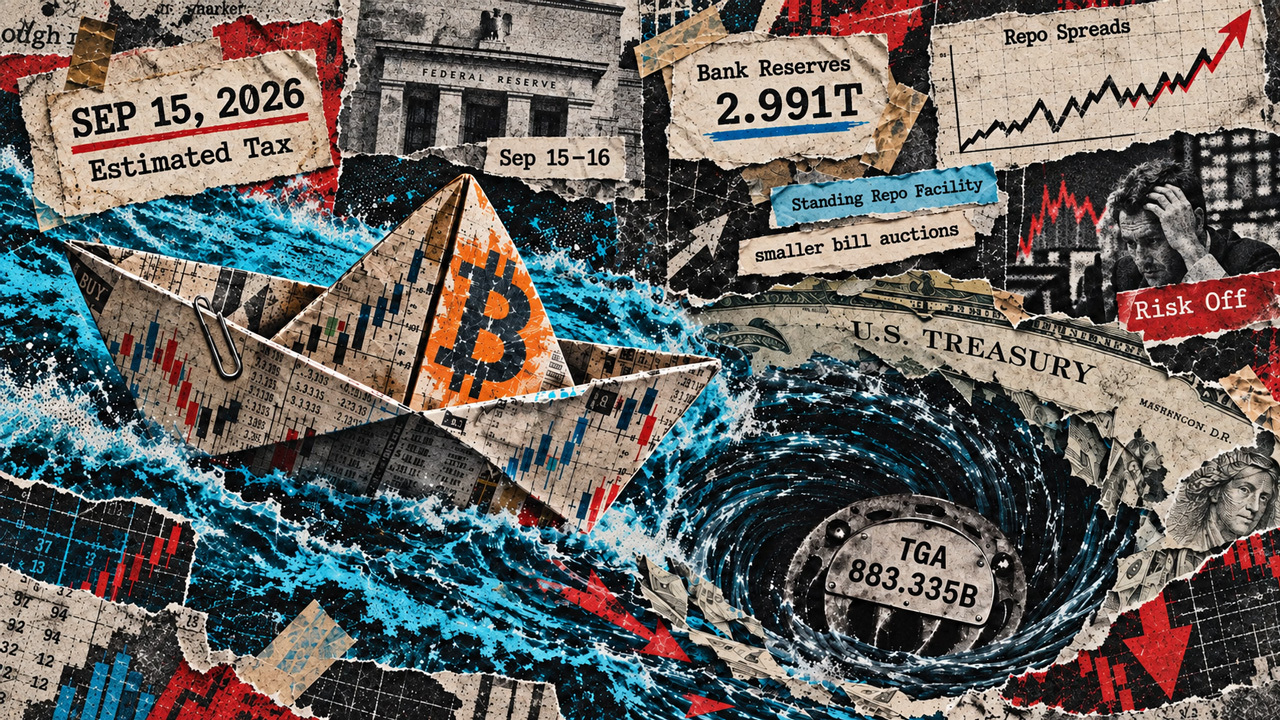
Bitcoin enters another macro liquidity test as U.S. tax payments drain cash from the financial system. The effect is temporary, but it can amplify volatility when ETF flows, Fed policy and leveraged positioning are already fragile.
Bitcoin faces another short-term liquidity test as the September U.S. tax deadline pulls cash from households, corporations and financial markets.
Tax dates matter because payments to the Treasury can temporarily move money out of private bank accounts and into the government’s cash balance.
That process can reduce liquidity available across risk assets even when there is no direct crypto-specific catalyst.
The effect should not be confused with a permanent tightening of financial conditions.
Tax-related cash drains are seasonal and can reverse as government spending puts money back into the banking system.
The relevance for Bitcoin comes from timing.
The market is already dealing with spot ETF outflows, a Federal Reserve meeting, elevated Treasury yields and larger leveraged short positions in futures.
A temporary liquidity drain can have a larger price effect when several other sources of demand are already uncertain.
Bitcoin is also unusually sensitive because it trades continuously.
Traditional markets close overnight and on weekends, but crypto can absorb liquidity stress immediately as investors rebalance collateral, hedge or reduce leverage.
That makes the tax deadline less important as a standalone bearish catalyst and more important as a stress multiplier.
The market response will depend on whether other liquidity channels offset the drain.
Strong ETF inflows, a softer Fed message or lower Treasury yields could easily dominate a seasonal tax effect.
The opposite combination would be more dangerous: tax-related cash withdrawal, continued ETF redemptions, higher yields and forced deleveraging at the same time.
Investors should also avoid treating one-day price moves around the deadline as proof of a new trend.
The better signal is whether Bitcoin weakens while money-market and funding indicators also tighten.
What investors should watch: Treasury cash-balance changes, spot Bitcoin ETF flows, repo conditions, Bitcoin’s reaction around the tax deadline and whether volatility rises into the Fed decision.
BTI’s bottom line: the September tax deadline is a real but temporary liquidity headwind. It becomes investment-relevant only if it overlaps with weaker ETF demand, tighter funding and a hawkish Fed outcome.
Continue your BTC research
Related News

Strategy's Rally Was About Bitcoin, Not Stablecoin Rules
Strategy rose more sharply than bitcoin after the OCC finalized stablecoin rules, but the company does not issue a stablecoin. Its move reflects leveraged bitcoin exposure, while debt and index-eligibility decisions amplify both upside and downside.

Riot's $9.1 Billion AI Lease Still Needs Financing and Delivery
Riot's 191-megawatt AI lease offers substantial contracted revenue, but the build requires more than $2 billion of capital. Financing terms, construction timing and losses remain the decisive risks.

Crypto Miners Rebound Despite Lower Targets and Costlier Debt
MARA and Hut 8 gained about 4% after Piper Sandler cut targets but kept Overweight ratings. The rebound shows investors separating long-term data-center potential from near-term financing risk.

OCC Stablecoin Rules Favor Coinbase's USDC Economics
The OCC finalized federal stablecoin rules covering reserves, redemption and risk management. Coinbase benefits indirectly through USDC distribution and rewards, while Circle faces the more direct issuer obligations and interest-rate exposure.

Strategy’s Five-Year Surge Still Depends on Bitcoin, Not Software
Strategy’s long-term share gains came from leveraged Bitcoin exposure rather than a revival in its software business. That structure can amplify cryptocurrency upside, but dilution, financing costs and sharp drawdowns remain central risks.

Strategy’s Daily STRC Dividend Plan Targets Lower Funding Costs
Strategy wants STRC to pay dividends every calendar day at a 12% annual rate, subject to an October 28 vote. Better liquidity could lower borrowing costs, but the payout is conditional.
DeFi Development Adds SOL as CHAD Dividend Rate Rises to 14%

DeFi Development Corp. added 3,983 SOL and SOL equivalents during the week ended October 16, lifting its treasury to about 2,590,266 SOL and equivalents. The company is also raising the annual dividend rate on its Variable Rate Series C Perpetual Preferred Stock, traded as CHAD, to 14% from 13%.
The new rate takes effect in early November. On CHAD's $10 stated amount, it equals $1.40 of annualized dividends per share, an increase of about 7.7% from the prior payout. The dividends are cumulative and calculated for each business day, but payment still depends on declaration by the board's dividend committee. Investors should not treat the quoted rate as a government bond yield or a guaranteed return.
DeFi Development's operating model links the preferred security to a crypto-treasury business. The company holds and stakes SOL, operates validator infrastructure and earns staking rewards and fees from delegated assets. It also runs a software business serving commercial real estate professionals. The treasury strategy gives common shareholders exposure to changes in SOL per share, but it also exposes the balance sheet to token-price volatility.
Management presented the higher CHAD rate as both an income product and a funding tool for expanding the SOL treasury. That creates a tradeoff. Issuing more preferred shares may provide capital without immediately issuing common stock, yet it adds cumulative dividend obligations ahead of the common equity. The attractive headline rate is therefore partly compensation for credit, liquidity and crypto-asset risk.
The timing also coincides with Solana's Alpenglow upgrade. Company materials describe Alpenglow as targeting transaction finality of roughly 150 milliseconds, down from about 12.8 seconds. Faster settlement could support payments and tokenized assets, but technical improvement does not by itself determine SOL prices or DeFi Development's financing capacity.
The key metrics are not only treasury size and the preferred rate. Investors should monitor SOL per share, staking income, preferred issuance, cash dividend coverage and any dilution needed to fund further purchases.
Coinbase's Tokenized-Stock Business Is Growing, but the Metrics Conflict

Coinbase executive John D'Agostino said the company's tokenized-stock product was running at about $20 million a week, an early sign of demand for securities that trade on blockchain rails. The figure is difficult to interpret because he did not specify whether it measured trading volume, new token issuance, assets or another activity.
Other public numbers do not reconcile cleanly. Blockworks reported about $12 million of activity on launch day, while Base creator Jesse Pollak later cited daily volume of $70 million to $100 million. Binance's bStocks product has reported more than $1 billion of assets and over $40 billion of cumulative volume. These figures may describe different measures and periods, so they should not be treated as a single growth series.
Coinbase launched the product on August 24 through Base and its Abu Dhabi tokenization hub. It was not offered to US persons. The company had received Financial Services Permission from Abu Dhabi's Financial Services Regulatory Authority to build an international platform for tokenized securities backed by underlying shares.
The product began with roughly 50 stocks, with an expectation that the menu could reach about 250. The appeal is straightforward: blockchain settlement can support longer trading hours, smaller fractional positions and use of securities as onchain collateral.
The risks are equally concrete. A token holder depends on the legal claim to the underlying share, custody arrangements, market-making liquidity and the rules of the jurisdiction where the product is sold. A token that tracks a stock is not automatically identical to holding that stock through a conventional broker.
For Coinbase, tokenized equities could diversify revenue beyond crypto trading and deepen activity on Base. Yet the lack of a consistent reported metric makes it premature to declare the business large. Investors should ask Coinbase to define weekly activity, disclose assets and volume separately, and explain how much revenue the product produces.
The strategic opportunity is real, but the most useful next milestone is better disclosure rather than a larger headline number.
OCC Stablecoin Rule Leaves Room for Third-Party Rewards

The Office of the Comptroller of the Currency has finalized rules for payment stablecoin issuers under the GENIUS Act, clarifying an important distinction between issuer-paid interest and rewards offered by separate platforms.
The law bars a permitted payment stablecoin issuer from paying interest or yield directly to holders. In its proposal, the OCC considered a rebuttable presumption that could have treated some payments by affiliates or related third parties as indirect violations. The final rule removed that presumption.
That change does not create a blanket safe harbor. The OCC said arrangements will be evaluated case by case, and a third party cannot simply act as a conduit for an issuer to evade the prohibition. Still, the removal gives exchanges and wallet providers more room to design loyalty or incentive programs funded from their own economics.
Coinbase has offered eligible customers a 3.75% reward on USDC balances. The final rule reduces the immediate risk that every such program would be presumed unlawful, but it does not settle whether any specific arrangement complies. Funding, control and the relationship between the platform and issuer will matter.
The rule also sets core operating requirements. Stablecoin reserves must at least equal outstanding tokens, and issuers generally must redeem at par within two business days. Those provisions address liquidity and payment reliability, while separate anti-money-laundering rules remain unfinished.
The final rule is scheduled to take effect on January 18, 2027, when the GENIUS Act becomes effective. Banks and other commenters had urged a broad prohibition on third-party yield, while crypto companies argued that loyalty programs should remain available. The OCC chose a narrower legal test rather than an automatic ban.
For Coinbase, the result is modestly constructive because USDC rewards can remain part of customer acquisition and retention, subject to compliance. The larger business effect will depend on the economics of those rewards, the final anti-money-laundering regime and how aggressively supervisors interpret indirect issuer involvement.
Securitize Adds Direct Stablecoin Access Through Anchorage Bank

Securitize is connecting its tokenized-asset platform directly to Anchorage Digital Bank's stablecoin infrastructure, removing a layer of intermediaries from the cash side of digital-asset settlement.
Under the partnership announced by Anchorage Digital, Securitize will be able to mint and redeem stablecoins issued by Anchorage Digital Bank. The bank will also handle custody and settlement. That structure gives institutions one regulated counterparty for creating digital dollars, holding them and using them to settle transactions in tokenized funds or securities.
The operational gain is straightforward. A platform that must obtain stablecoins through outside dealers faces additional transfers, counterparties and reconciliation steps. Direct minting and redemption can shorten that chain. It does not eliminate blockchain, issuer, banking or smart-contract risk, and the announcement does not provide transaction fees, minimum sizes, expected volumes or a firm implementation timetable.
Anchorage said its bank-issued stablecoin ecosystem includes USDtb, developed with Ethena Labs, and USA₮, developed with Tether, among other current and planned issuances. The Securitize announcement did not identify which tokens will be available first, so it would be premature to assume full access to every Anchorage-supported stablecoin.
The partnership also links two parts of the tokenization market that already overlap. Anchorage reported that about 99% of USDtb's $530 million of reserves at August 31 were held in BlackRock's BUIDL tokenized fund, which Securitize services. Securitize says its platform supports tokenized products from large asset managers and private-market firms.
For Securitize, which trades under SECZ, the deal expands infrastructure rather than creating a disclosed new revenue stream. Investors still need evidence on adoption, pricing and whether direct bank connectivity brings more assets onto the platform. For Anchorage, the agreement adds a distribution channel for federally supervised stablecoin issuance.
The most important next disclosures are practical: which tokens launch, which clients use them, how quickly mint and redemption requests settle, and whether the arrangement reduces cost. Until those numbers arrive, the announcement is a credible improvement to the settlement stack, not proof of material earnings growth.
Halliburton Sees 15% Margins Without a Fracking Recovery

Halliburton's early 2027 outlook rests on an unusually important assumption: the company does not need a recovery in North American hydraulic fracturing to reach its target. Management expects mid-single-digit revenue growth and an operating margin of about 15%, roughly two percentage points above its current outlook.
The third quarter showed why that mix shift matters. Revenue was $5.7 billion, broadly unchanged from the second quarter. North American revenue fell 5% to $2.2 billion, primarily because of weaker pressure-pumping activity. International revenue rose 3% to $3.5 billion, including an 8% increase in the Middle East and Asia to $1.4 billion.
Segment results reinforced the contrast. Drilling and Evaluation revenue increased 4% to $2.6 billion, while operating income rose 16% to $391 million. Completion and Production revenue declined 4% to $3.1 billion, and operating income fell 4% to $457 million as stimulation activity weakened in the Western Hemisphere.
Reported and adjusted results also moved in different directions. Net income attributable to Halliburton fell to $417 million from $534 million in the second quarter. Adjusted net income rose to $501 million from $461 million, and adjusted earnings per share increased to $0.60 from $0.55.
The difference reflects $107 million of pre-tax charges, mainly severance costs from a global restructuring and inventory write-downs. Investors should not ignore those costs, but the adjusted improvement suggests the underlying business performed better than the reported decline alone implies.
Cash conversion remains a near-term watchpoint. Operating cash flow was $368 million and free cash flow was $156 million, while share repurchases totaled about $250 million. That means buybacks exceeded quarterly free cash flow.
The 2027 margin target is credible only if international growth continues, restructuring savings appear and North American pressure pumping does not deteriorate further. A flat fracking market may be enough for management's plan, but a deeper decline would test the claim that international activity can carry the whole improvement.
Latest comments