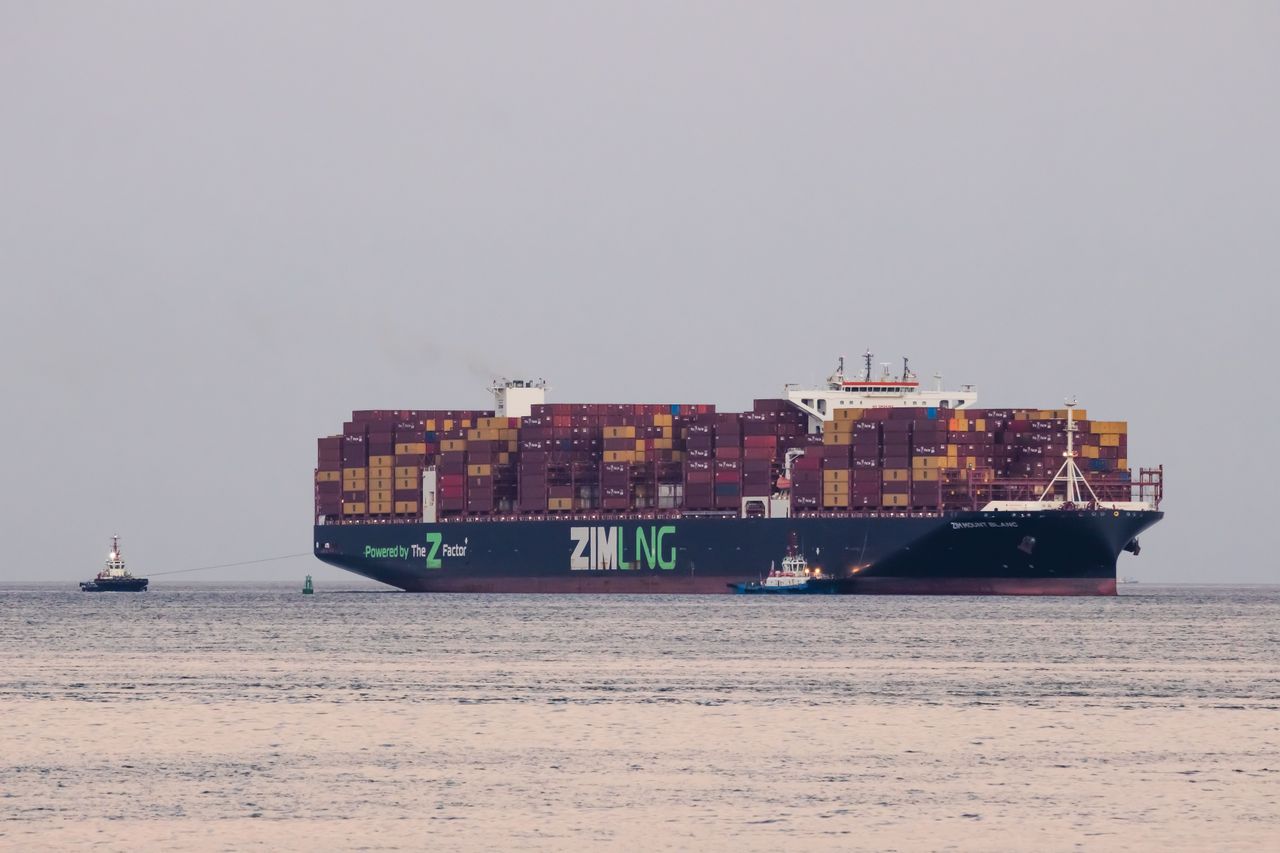
ZIM has made its standalone earnings outlook materially stronger while shareholders wait for a $35-a-share cash merger that still carries political and execution risk. On October 6, the container carrier raised 2026 adjusted EBITDA guidance to $2.7 billion-$3.0 billion from $2.0 billion-$2.4 billion and adjusted EBIT guidance to $1.4 billion-$1.7 billion from $700 million-$1.1 billion.
The midpoint changes are large. Adjusted EBITDA rises from $2.2 billion to $2.85 billion, a $650 million or 29.5% increase. Adjusted EBIT rises from $900 million to $1.55 billion, a $650 million or 72.2% increase. Because the dollar increase is identical, the revision implies that management's changed assumptions flow mainly above depreciation and amortization. It does not automatically translate dollar-for-dollar into net income or distributable cash.
A stronger floor under the merger spread
Hapag-Lloyd agreed in February to acquire ZIM for $35 in cash per share. The source reported ZIM around $29.20, leaving $5.80 of gross upside, or 19.9% relative to the market price. That spread is compensation for the time to close, regulatory and Israeli-state approvals, financing and the possibility of a competing outcome. It is not free return.
The revised guidance changes the downside discussion. At the new midpoint, ZIM's 2026 adjusted EBITDA would exceed the $2.17 billion it reported for 2025 by about 31%, using the company's [full-year 2025 release](https://investors.zim.com/news/news-details/2026/ZIM-Reports-Financial-Results-for-the-Fourth-Quarter-and-the-Full-Year-of-2025/default.aspx). Full-year 2025 revenue was $6.90 billion and adjusted EBIT was $885 million. A company producing substantially more operating profit than investors expected in August should be worth more on a failed-deal basis, all else equal.
That is only a partial cushion. Container shipping profits are highly cyclical. Freight rates can move faster than reported annual earnings, and ZIM leases much of its fleet, which creates fixed charter obligations when rates weaken. Red Sea disruptions, Middle East conflict, bunker costs, vessel supply and trade demand can lift or erode earnings rapidly. The [guidance release](https://investors.zim.com/news/news-details/2026/ZIM-Raises-Full-Year-2026-Guidance/default.aspx) expressly lists geopolitical conditions, freight rates, fuel and industry capacity among the uncertainties.
The offer still matters more than one year's earnings
An arbitrage investor should separate three values: $35 if the Hapag-Lloyd transaction closes on its stated terms; a standalone value if it fails; and any higher outcome from a competing proposal. The reported alternative backed by FIMI involved a smaller operating combination and lacked the same simple cash benchmark. A revised proposal may arrive, but shareholders cannot value an unannounced structure as though it were binding.
The Israeli regulatory process is also more nuanced than a single hurdle. ZIM's strategic status and the state's special share create national-interest considerations around headquarters, fleet availability and control. The source said a regulator completed a review of the Golden Share arrangement on September 29, while the Hapag-Lloyd deal still required remaining steps and was expected to close around year-end. Completion of one review is progress, not final closing.
Time value narrows the apparent return. If $35 is received three months after a $29.20 purchase, the gross spread is still 19.9%, but an investor must reserve capital through closing and accept event risk. If the timetable slips six months, the annualized return falls even if the ultimate cash price is unchanged. Borrowing cost and taxes further reduce realized arbitrage returns.
The market spread can be translated into a simple scenario, though the result depends entirely on assumptions. If an investor assigns a 75% probability to receiving $35 and a 25% probability to a $22 failed-deal value, the probability-weighted value is $31.75 before time value: 0.75×$35 plus 0.25×$22. At $29.20, that hypothetical offers $2.55 of expected upside. If the close probability falls to 60%, the same downside assumption produces $29.80. This is BTI scenario analysis, not a forecast; changing the standalone value by a few dollars materially changes the result.
What the next evidence must show
The raised outlook must be tested against volumes, average freight rate, bunker expense, charter costs and cash conversion. The company's [second-quarter release](https://investors.zim.com/news/news-details/2026/ZIM-Reports-Strong-Results-for-the-Second-Quarter-of-2026-Benefiting-from-its-Leading-Transpacific-Position-Agile-Commercial-Approach-and-Efficient-Cost-Structure/default.aspx) had set the prior ranges, so the October revision is a genuine change rather than a restatement.
For merger investors, formal Israeli approvals, shareholder communications and a definitive response to any competing proposal are the catalysts. For standalone holders, the key question is whether the freight-rate environment supporting the 2026 upgrade persists into 2027. The revised guidance improves the economic fallback, but the nearly 20% deal spread shows that the market still treats closing risk as substantial.