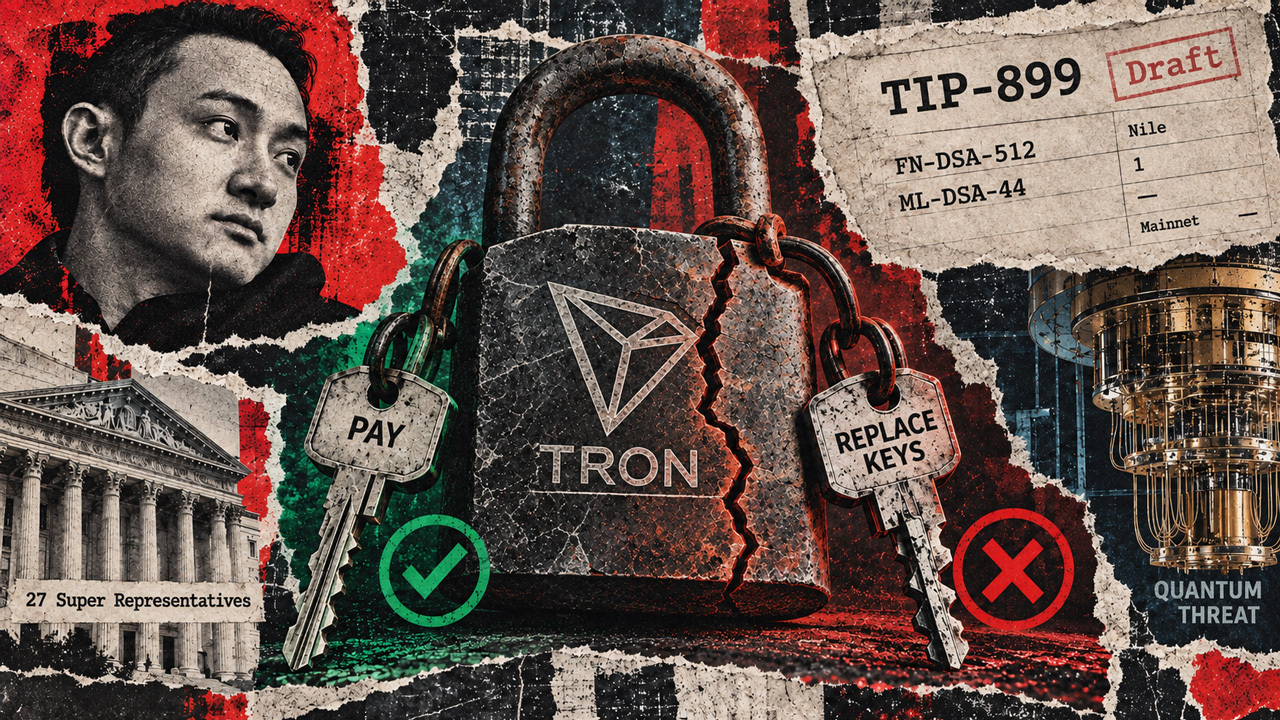
TRON’s emerging quantum-migration plan highlights a difficult problem that goes beyond choosing a new cryptographic signature scheme.
The supplied source describes an edge case where some wallets may still be able to spend funds while lacking a clean path to replace their existing key structure.
Quantum migration is not only about whether a blockchain can support new signatures.
It is also about whether every existing account can move safely from old credentials to new ones.
A post-quantum upgrade can protect future transactions.
It does not automatically solve legacy-account constraints.
If an account structure separates spending authority from key-replacement authority, users may face a situation where they can still transact but cannot upgrade the credential that secures future control.
That creates a migration bottleneck.
The blockchain may be technically ready for safer signatures while individual users remain trapped in old security assumptions.
This problem is especially relevant for inactive wallets and older accounts.
Active users can follow upgrade instructions, rotate keys and migrate assets.
Dormant accounts may not be monitored closely enough to act before a deadline.
The risk is not immediate quantum theft.
No current evidence shows quantum computers can break TRON’s live signature system today.
The investment relevance is preparedness.
Networks with clearer account migration rules can reduce future emergency risk.
Networks with ambiguous or incompatible account structures may need more complex governance decisions later.
That can affect exchanges and custodians as well.
Large platforms may have to coordinate key rotation across millions of addresses without disrupting deposits or withdrawals.
The more standardized the migration path, the easier that becomes.
Migration deadlines would also create behavioral risk.
If users are asked to rotate keys voluntarily, some will delay action until the last possible moment. Exchanges and custodians can automate much of that work, but individual wallets may remain untouched for years.
That creates a long tail of legacy exposure.
A network can reduce the problem by providing wallet warnings, standardized migration transactions and clear compatibility rules.
The governance challenge becomes harder if the protocol eventually considers limiting or freezing old key types.
Such measures can improve safety while creating serious questions about property rights and backward compatibility.
The cleaner the voluntary migration path, the less likely the network is to face those emergency choices later.
What investors should watch: TRON’s final migration proposal, key-rotation support, exchange implementation plans, treatment of legacy accounts, post-quantum signature choices and whether dormant users receive a clear upgrade path.
BTI’s bottom line: TRON’s quantum challenge is partly an account-design problem. A safer signature scheme only works if users can actually move into it, and legacy wallets may be the hardest part of that transition.