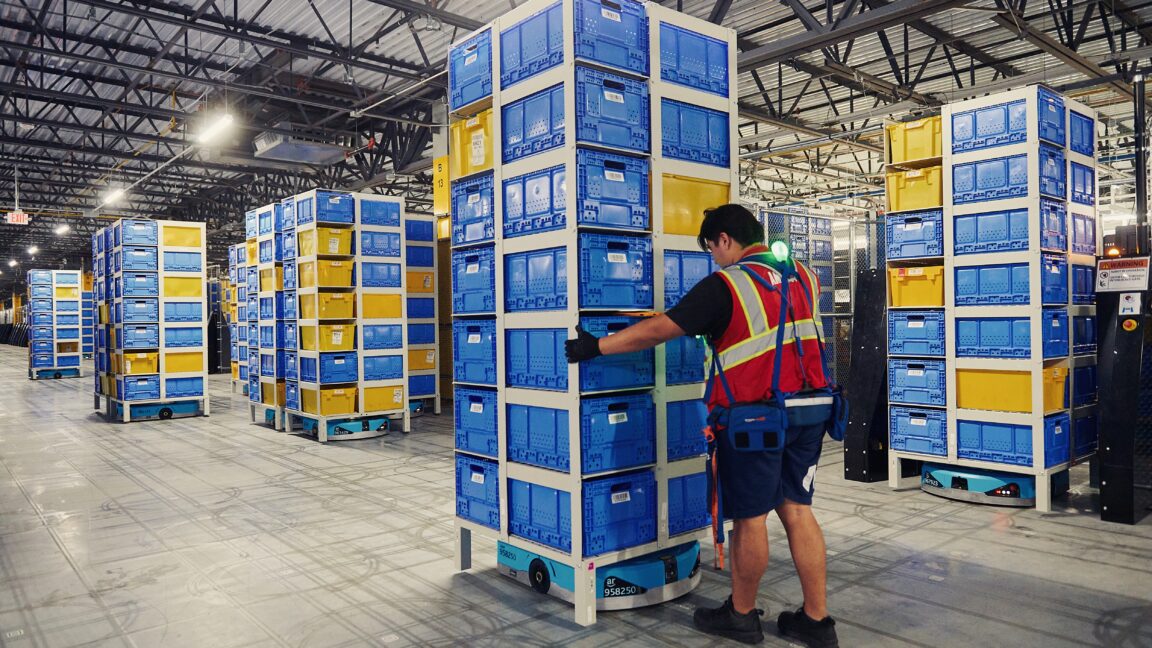
Amazon has built a fleet of more than one million warehouse robots and is adding factories to manufacture more of them. At Amazon's scale, even small gains in package handling can affect delivery speed, labor requirements and fulfillment costs. The investment question is not whether automation is growing, but whether it produces durable savings without creating new operational and labor risks.
Scale turns small improvements into money
Amazon says its robots operate in more than 300 facilities and assist with 75% of customer orders it delivers worldwide. The company plans an Austin facility with 300 to 500 manufacturing and engineering jobs and another Indiana plant with 300 skilled jobs. Bringing more robotics production in-house can improve supply control and shorten the cycle between design, testing and deployment.
The systems do different work. Mobile robots move inventory, robotic arms pick and sort packages, and the Proteus platform can move loads up to 1,300 pounds. These tools can reduce walking, heavy lifting and idle time. They can also improve throughput without requiring every incremental package to add the same amount of labor.
The economics are still partly hidden
Amazon does not separately report robotics capital spending, unit cost savings or payback periods. Investors therefore need to infer returns from fulfillment expense, delivery speed, inventory productivity and operating margin. A million robots is an engineering milestone, not a financial return metric.
The original reporting also describes a more complicated labor picture. Automation can reduce severe injuries by removing heavy tasks while increasing repetitive pace for people who remain in the process. Amazon cites substantial declines in global recordable and lost-time incident rates since 2019, but independent work using older warehouse data has found different injury patterns between robotic and legacy sites. Both claims can be true if automation shifts the type of risk rather than eliminating it.
Labor displacement is uncertain as well. Amazon says advanced sites create maintenance and engineering roles, while internal planning reported elsewhere has considered lower future hiring needs. Fewer projected hires are not the same as layoffs, and new facilities can create skilled jobs even as each building becomes less labor intensive.
What investors should watch
Track fulfillment expense as a share of sales, same-day delivery coverage, injury disclosures and hiring by job category. The most useful robotics disclosure would connect a system to throughput, labor hours, safety and payback. Watch whether the new manufacturing plants improve deployment speed and reliability.
BTI's bottom line
Amazon's robotics scale can widen its logistics advantage, but the financial case needs more than robot counts. Durable value requires lower cost per package, safer work and enough flexibility to handle demand changes without locking the network into expensive technology.