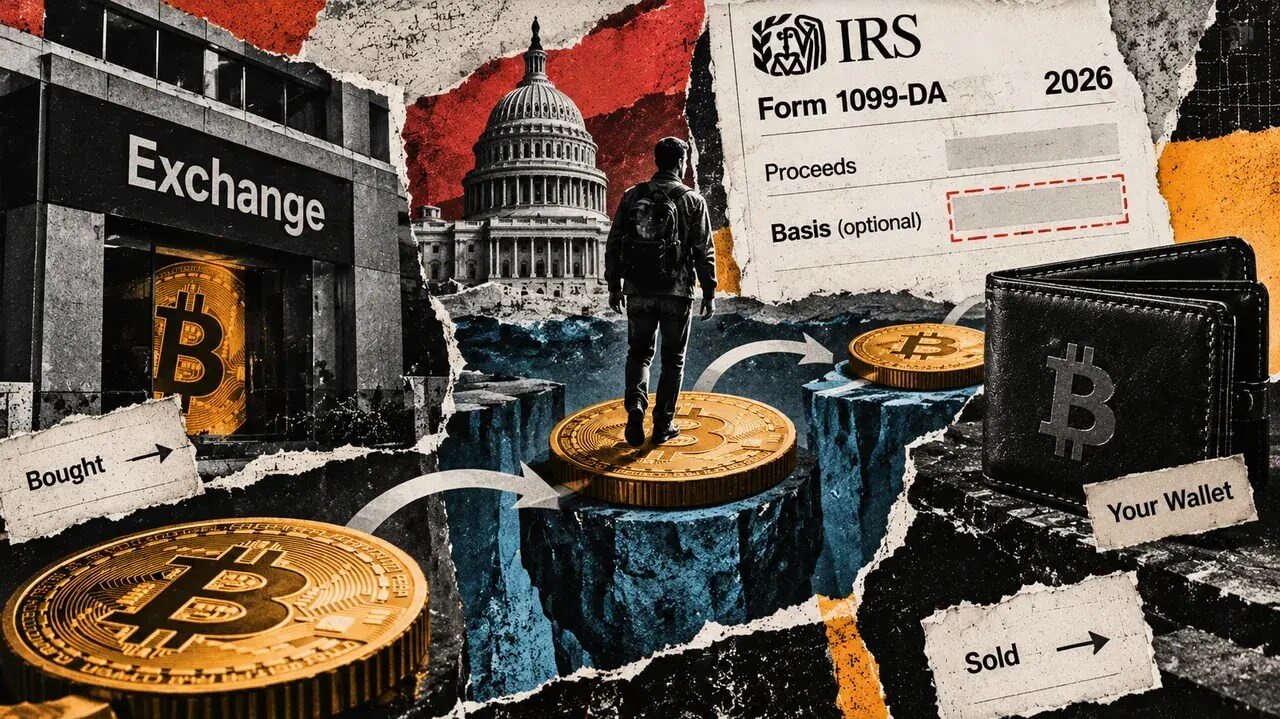
Bitcoin self-custody can create a major reporting gap under the 2026 U.S. tax regime because brokers may report sale proceeds without being required to report the original cost basis.
The supplied source explains that Form 1099-DA rules distinguish between covered and noncovered digital assets.
Assets generally need to be acquired after 2025 in the selling broker’s custodial account and remain there until disposal to receive mandatory basis reporting.
If Bitcoin is transferred out to a personal wallet and later returned, the sale can become noncovered for broker-reporting purposes.
The tax economics do not change.
If an investor bought 0.1 BTC for $5,000 and later sold it for $7,000, the gain remains $2,000 assuming no other adjustments.
The problem is documentation.
The broker may report $7,000 of proceeds while leaving basis reporting voluntary.
A blank basis field does not mean the investor’s cost was zero.
It means the investor has to prove the acquisition history.
That makes self-custody a recordkeeping responsibility.
Moving assets between wallets owned by the same taxpayer is generally not itself a taxable event, but the investor still needs records connecting the original purchase with the later sale.
Transfer fees can complicate the picture if crypto is used to pay them.
The challenge becomes larger when coins move across multiple exchanges and wallets.
One platform may know the purchase.
Another may know the sale.
Neither may have the complete history.
International reporting can increase transaction visibility without solving the cost-basis problem.
Tax authorities may receive more information about transfers and disposals while investors still need their own records to calculate gains correctly.
For long-term holders, this creates a practical risk.
Poor records can become expensive years later when coins are sold.
The recordkeeping burden also becomes more important as tax authorities receive better transaction visibility.
A taxpayer may face a situation where the government knows a sale occurred but the broker does not have enough information to report the correct basis.
That asymmetry makes incomplete personal records particularly risky.
Wallet software can help by tagging transfers between owned addresses and preserving lot history.
But automated tools can also make mistakes when assets pass through bridges, mixers, wrapped tokens or complex DeFi transactions.
For simple Bitcoin self-custody, the best defense remains straightforward documentation linking acquisition date, cost, transfer history and final disposal.
What investors should watch: broker 1099-DA implementation, basis-transfer tools, exchange reporting policies, wallet-recordkeeping software and whether the IRS provides additional guidance for returned self-custody assets.
BTI’s bottom line: self-custody does not change the economic gain, but it can break the broker’s reporting chain. Bitcoin investors need to treat cost-basis records as part of custody itself, not as paperwork to reconstruct after the sale.