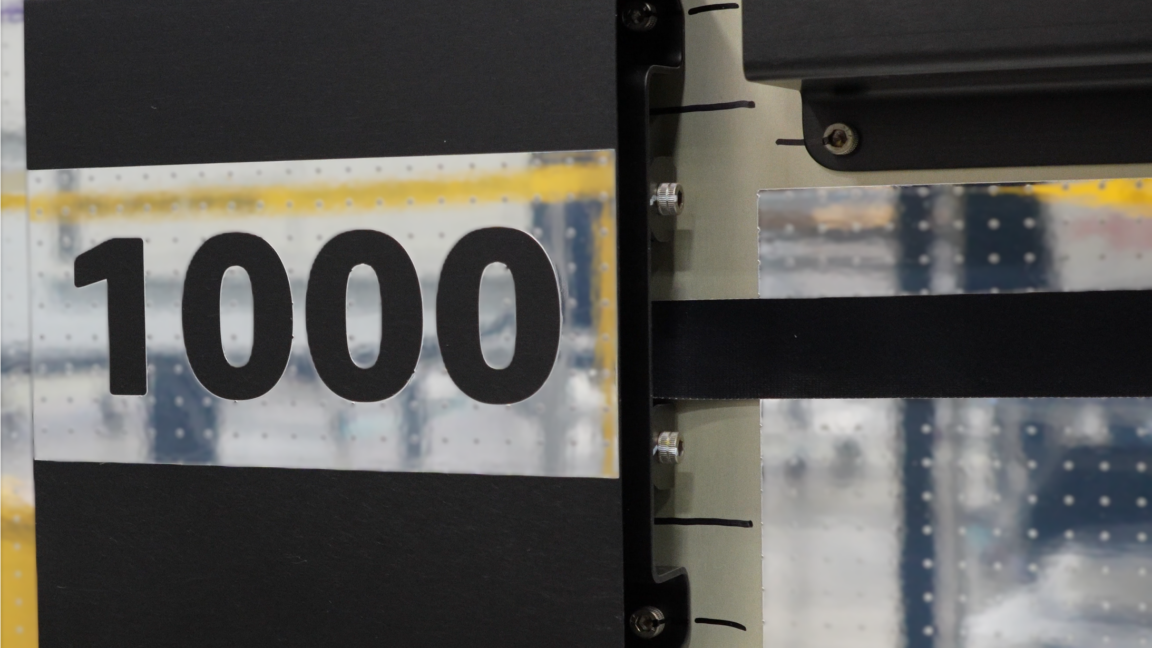
Amazon’s Leo broadband program has crossed a manufacturing milestone: the company says its Kirkland factory has produced its 1,000th satellite and can now build about 27 a week, up from six months for the first batch of 27. With nearly 400 satellites already in orbit, Amazon says it has enough coverage to begin initial service in 2026.
The milestone changes the investor question from whether Amazon can industrialize satellite production to whether launches and customer demand can convert that capacity into a durable service. Manufacturing 1,000 spacecraft is not the same as operating them, and only satellites successfully launched, raised into position and integrated with ground infrastructure can generate revenue.
Production is no longer the only bottleneck
Amazon built a 170,000-square-foot factory while the spacecraft design was still evolving. Management told Ars Technica that testing once measured in days or weeks can now be completed in hours, while each satellite still moves through the plant over several weeks. The company paces production to planned launches and maintains finished inventory so rockets do not wait for payloads.
Launch supply remains a major dependency. Amazon has booked more than 100 launches across Atlas V, Ariane 6, Falcon 9, Vulcan Centaur and New Glenn. Diversifying providers reduces single-rocket risk, but delays or anomalies can still strand completed satellites on the ground and postpone service coverage.
The commercial proposition
Amazon says Leo can deliver up to gigabit-class downlink and 400 megabits per second uplink for some enterprise configurations, with private-network connections into customer or AWS data centers. It has also announced a Delta Air Lines agreement for satellite Wi-Fi beginning in 2028. These commitments indicate enterprise interest, but Amazon has not disclosed consumer pricing, service revenue or customer acquisition costs.
The first-generation plan calls for 3,232 satellites, meaning the in-orbit fleet remains well below the full design. A larger constellation improves coverage and resilience but requires continued launch spending, ground stations, terminals and satellite replacement. That makes Leo a capital-intensive network rather than a conventional software add-on.
Strategic upside and financial discipline
For Amazon, the advantage is integration. Leo can connect remote customers to AWS, bundle with Prime or devices, and serve aviation, logistics and government markets. It can also challenge Starlink in a category where the leading competitor has enjoyed unusual scale and mindshare.
The counterargument is that Amazon is entering late and must fund the network before revenue becomes material. Technical performance claims still need to be demonstrated at commercial scale, and regulatory milestones remain jurisdiction-specific.
The next proof points are service launch, disclosed prices, active subscriber numbers and deployment cadence. The 1,000th satellite establishes manufacturing capability; it does not yet establish attractive returns on the billions committed to the constellation.
The production numbers also allow a simple scale check. Moving from 27 satellites in six months to 27 a week implies an annualized factory pace of roughly 1,400 units if sustained. BTI calculation: 27 multiplied by 52 weeks equals 1,404. That is enough to supply a large share of the remaining first-generation constellation over a few years, but only if launch capacity and final testing keep pace. The calculation is a throughput illustration, not company guidance.
Network economics will depend on utilization. Each launch and satellite is largely a fixed cost, while an additional customer can contribute recurring revenue once coverage and terminal capacity exist. That creates operating leverage after the network reaches useful density, but it also creates losses when satellites are underused. Enterprise aviation and government contracts can help anchor demand, while consumer service requires affordable terminals, installation and support.
Amazon’s next disclosures should therefore be evaluated in a sequence: satellites launched rather than merely built, usable coverage, terminal availability, customer count, revenue, and eventually operating margin. Skipping directly from factory output to an earnings valuation would ignore the most capital-intensive steps.
Competition also disciplines pricing. Starlink’s installed base forces Amazon to win on performance, enterprise integration or bundled value rather than relying on novelty.